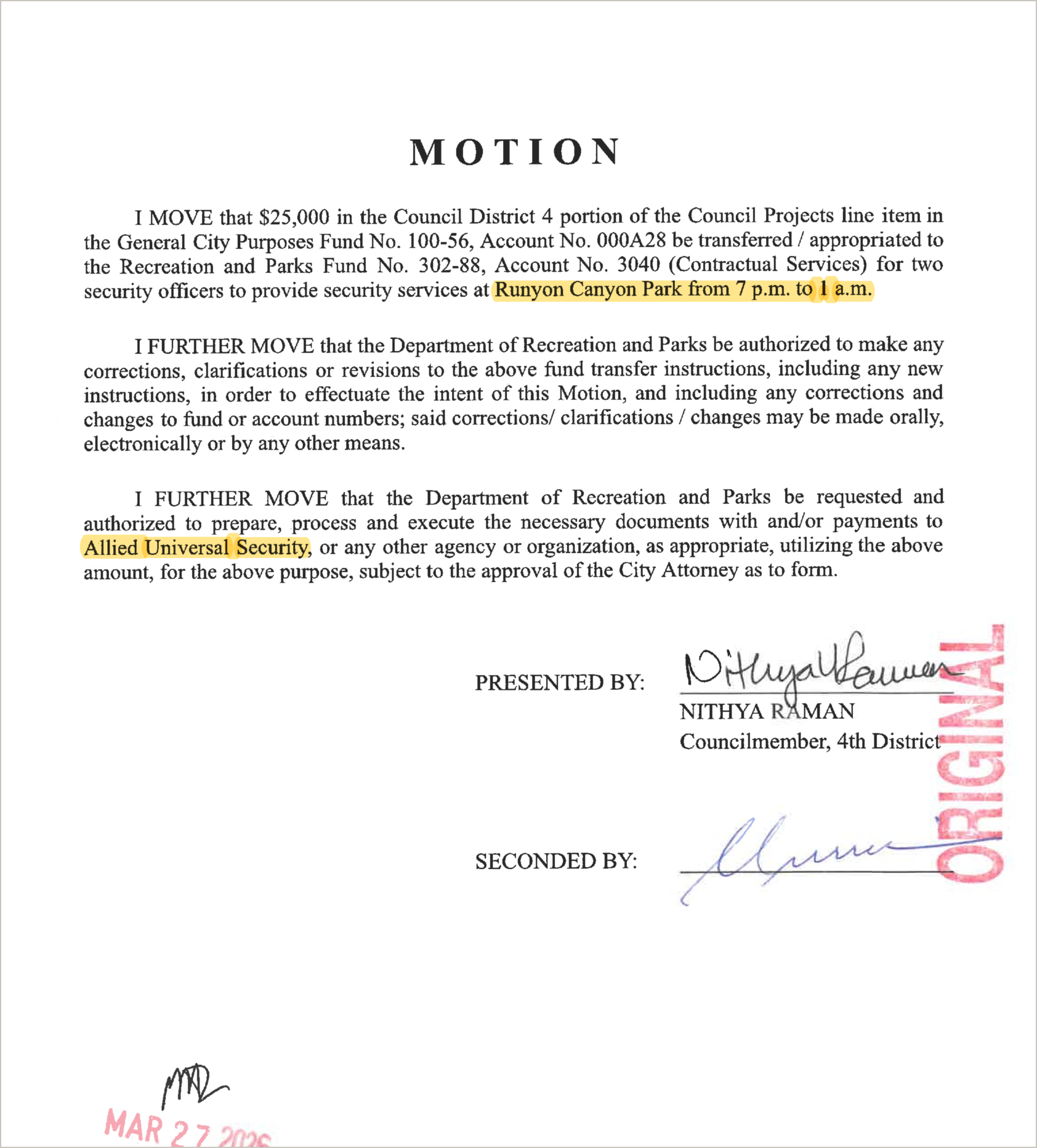

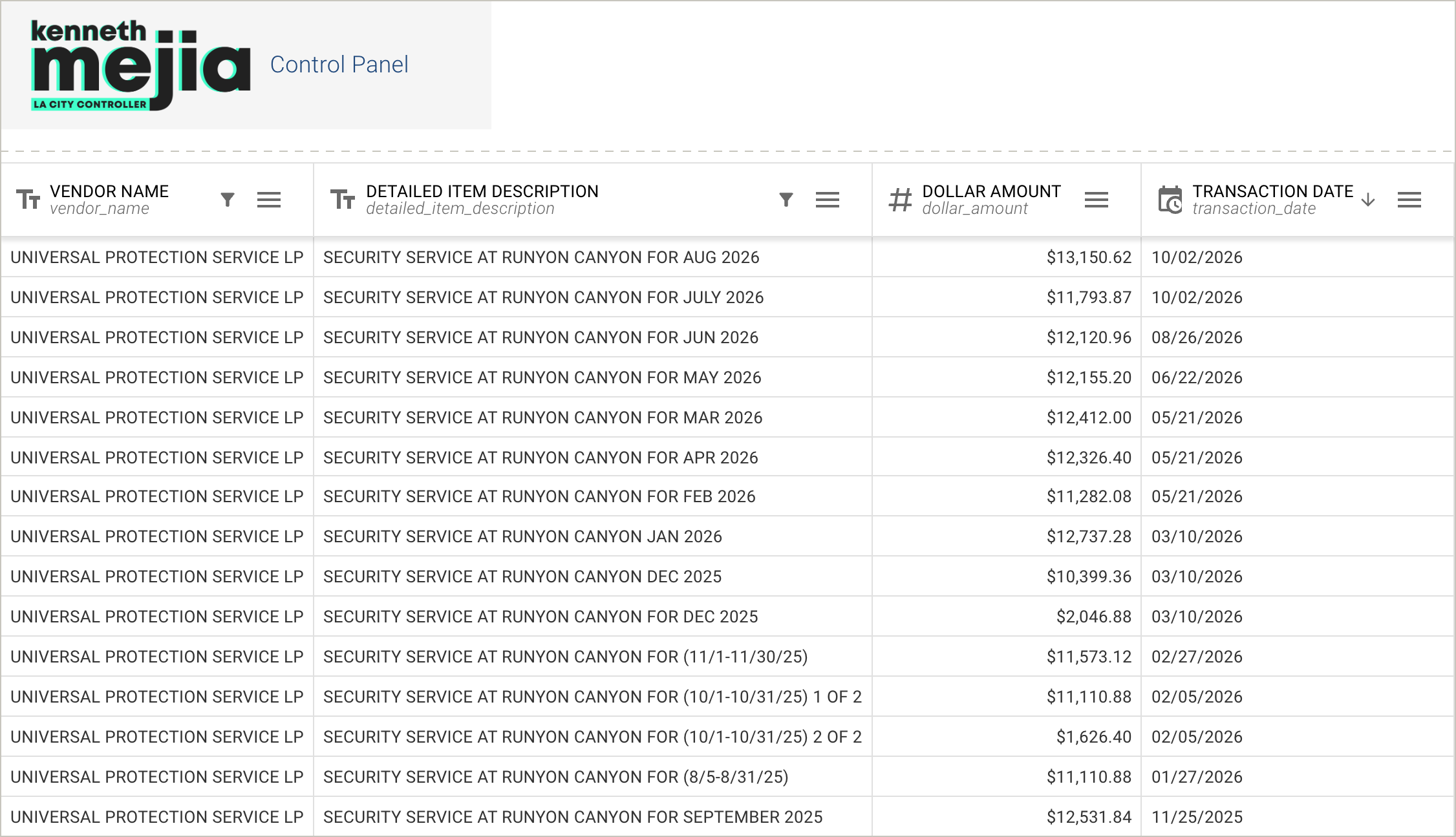
The City of Los Angeles has paid for security at Runyon Canyon Park since August 2025, at about $12,000 a month, and every one of those bills has gone to Allied Universal under its legal name, Universal Protection Service LP. In April the City Council voted 15 to 0 to put $25,000 more toward “two security officers to provide security services at Runyon Canyon Park from 7 p.m. to 1 a.m.,” with the payments to go to “Allied Universal Security.”

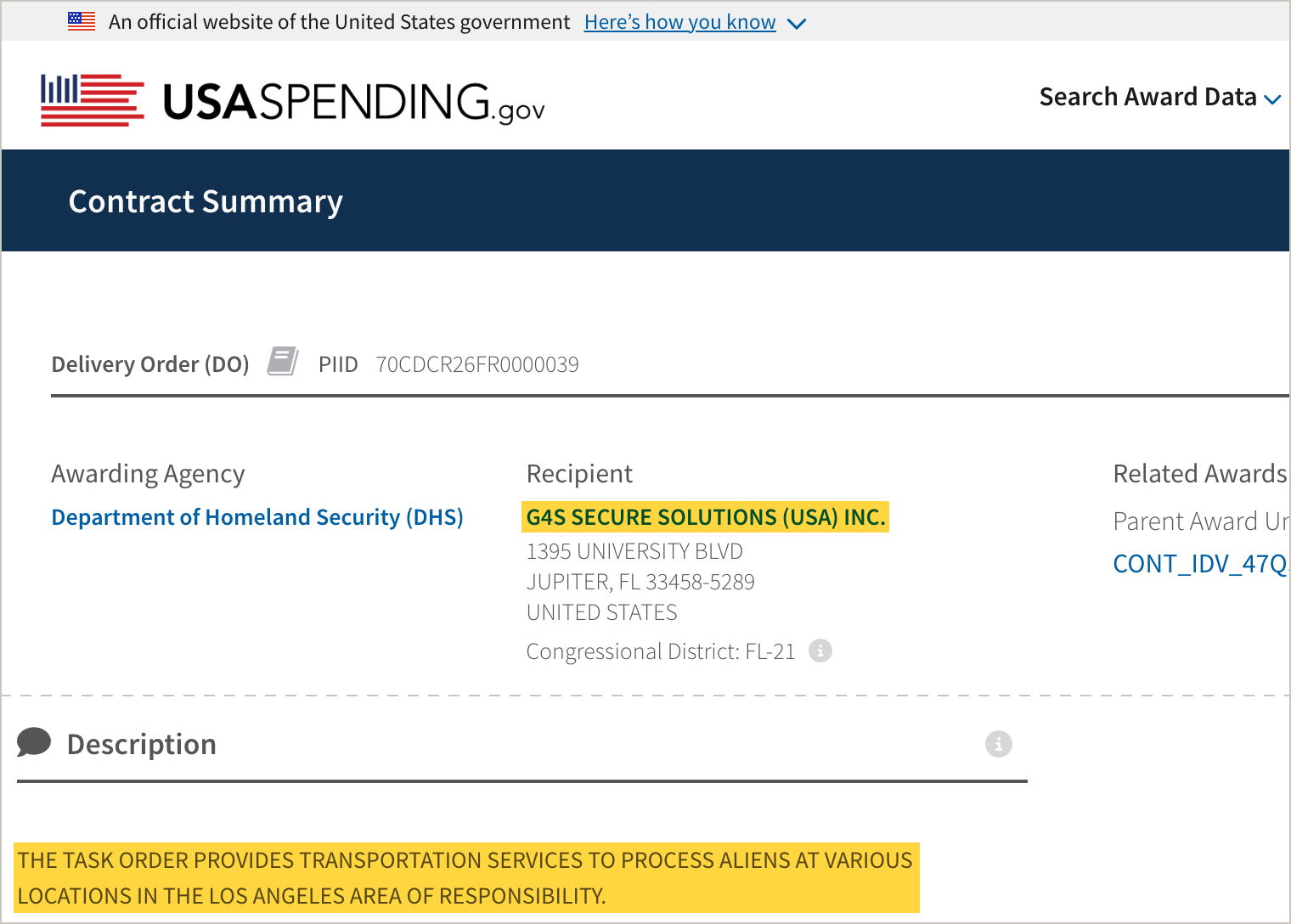
Allied Universal, which is headquartered in Irvine and suburban Philadelphia, also owns G4S Secure Solutions (USA), which it bought in April 2021, and G4S is one of the companies U.S. Immigration and Customs Enforcement pays to move the people it detains. In February, ICE signed G4S to a task order that, in the agency’s words, “provides transportation services to process aliens at various locations in the Los Angeles area of responsibility.” ICE has committed $14.2 million to that order, which runs through October 28, and had paid out $5.2 million of it by early October.

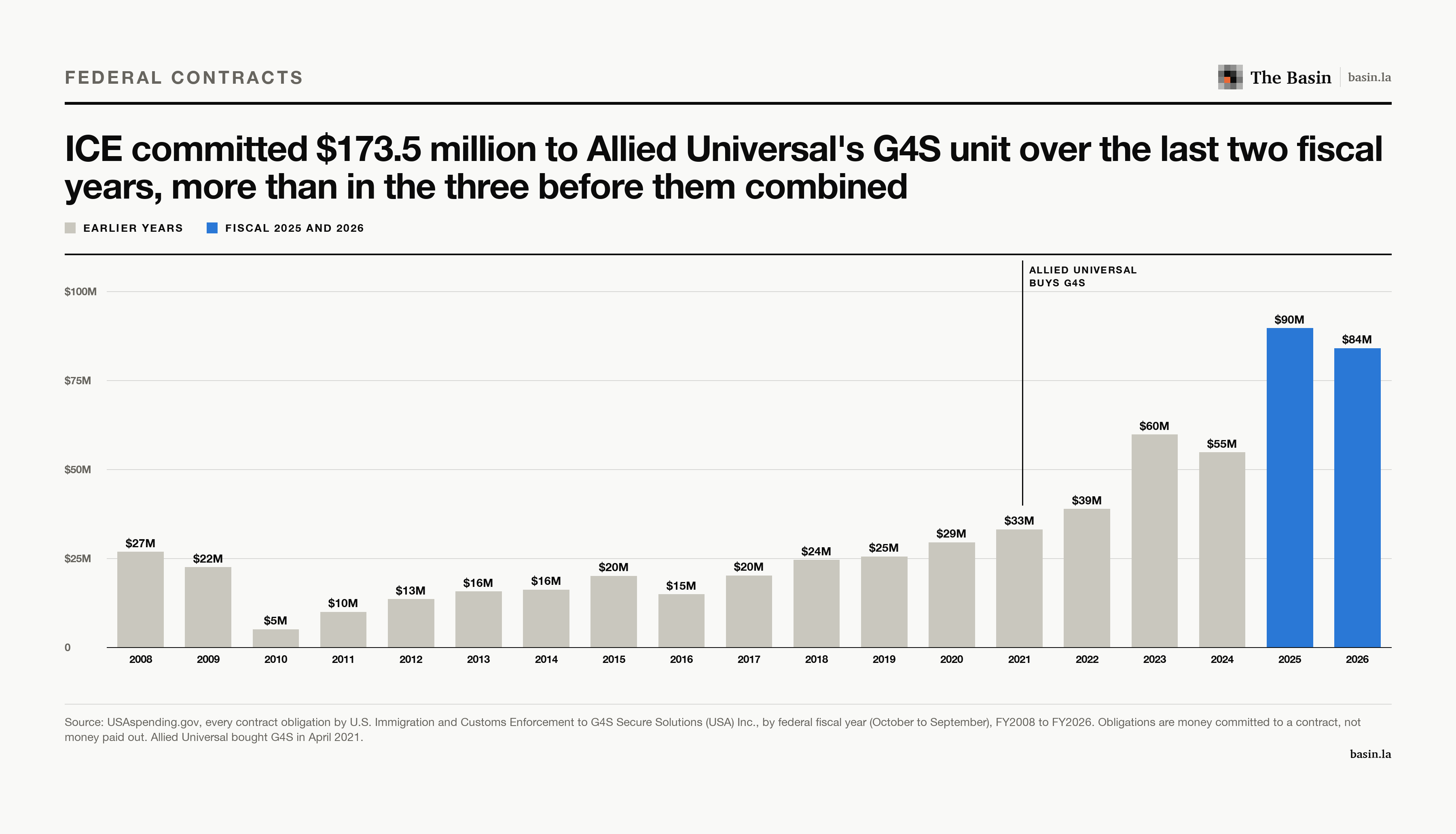
Across the country, ICE committed $173.5 million to G4S over the two federal fiscal years that ran from October 2024 to September 2026, more than it committed to the company in the three years before them combined, and $157.7 million of it came after President Trump took office on January 20, 2025. Over the same 24 months, Los Angeles paid Allied Universal $7.6 million, most of it for guards at the Department of Water and Power, the Sanitation bureau’s Lopez Canyon yard and its transfer station near downtown, police facilities and the long-closed Lincoln Heights Jail. None of the city’s money pays for immigration work, and nothing in the city’s records ties its guard contracts to G4S’s federal business. The guards at Runyon Canyon and the officers in ICE’s transport vans work for companies with the same owner.
Of the companies ICE pays to hold or move people in California, G4S is the only one that also turns up in the city’s payment records. GEO Group and CoreCivic, which run seven of the state’s eight immigration detention centers, have drawn far more from ICE in California, but neither appears in the city’s payment records.
G4S has carried people for ICE for a long time. The federal spending records of its ICE work begin in fiscal 2008, when the agency committed $26.8 million to the company, and its work in California alone has drawn $311.4 million since 2009. About $147.5 million of that came through ICE’s Los Angeles field office, which covers seven Southern California counties. The contracts call the job “transportation (detention officer) services” and “armed detention officers transportation services,” and the government files it under the same industry code it uses for any company that supplies security guards and patrols.


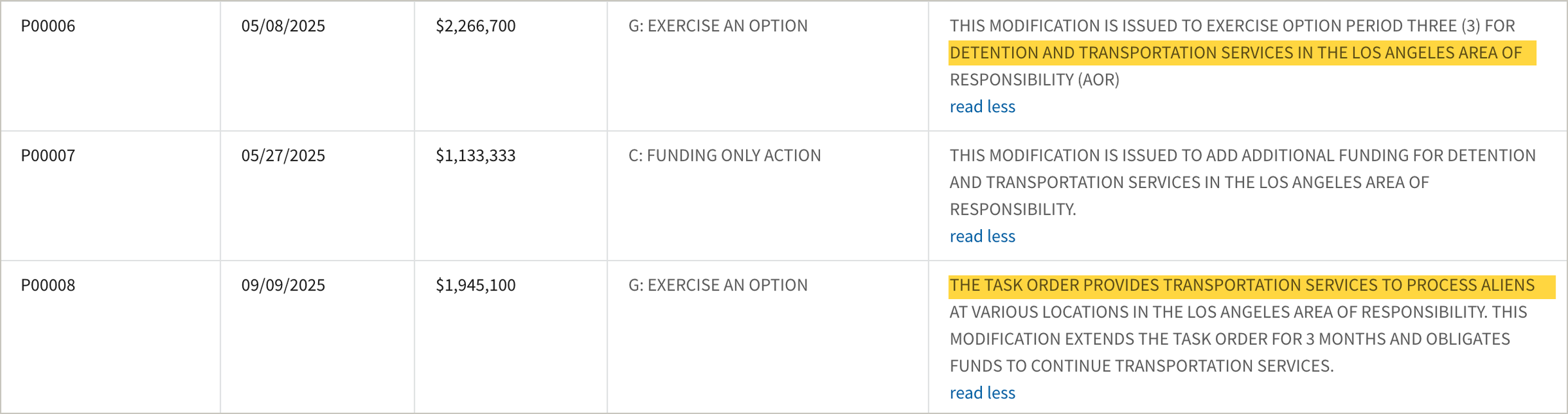
ICE’s spending on G4S in its Los Angeles field office rose from $9.0 million in fiscal 2024 to $12.6 million in 2025 and $16.2 million in 2026. The task order ICE used there from July 2024 to February 2026 shows when the money picked up. ICE exercised an option on it “for detention and transportation services in the Los Angeles area of responsibility” on May 8, 2025, and added $1.1 million for the same services on May 27, ten days before federal agents began the raids across Los Angeles on June 6. By September its modifications were describing the work the way the current order does, as transportation “to process aliens at various locations.” ICE committed $16.6 million to that order and paid out $16.3 million before it closed.
G4S’s work for ICE’s San Francisco field office grew too. In September 2025 ICE signed G4S to a two-year order for “ground transportation services in support of Enforcement and Removal Operations” across Northern California and has committed $29.4 million to it.
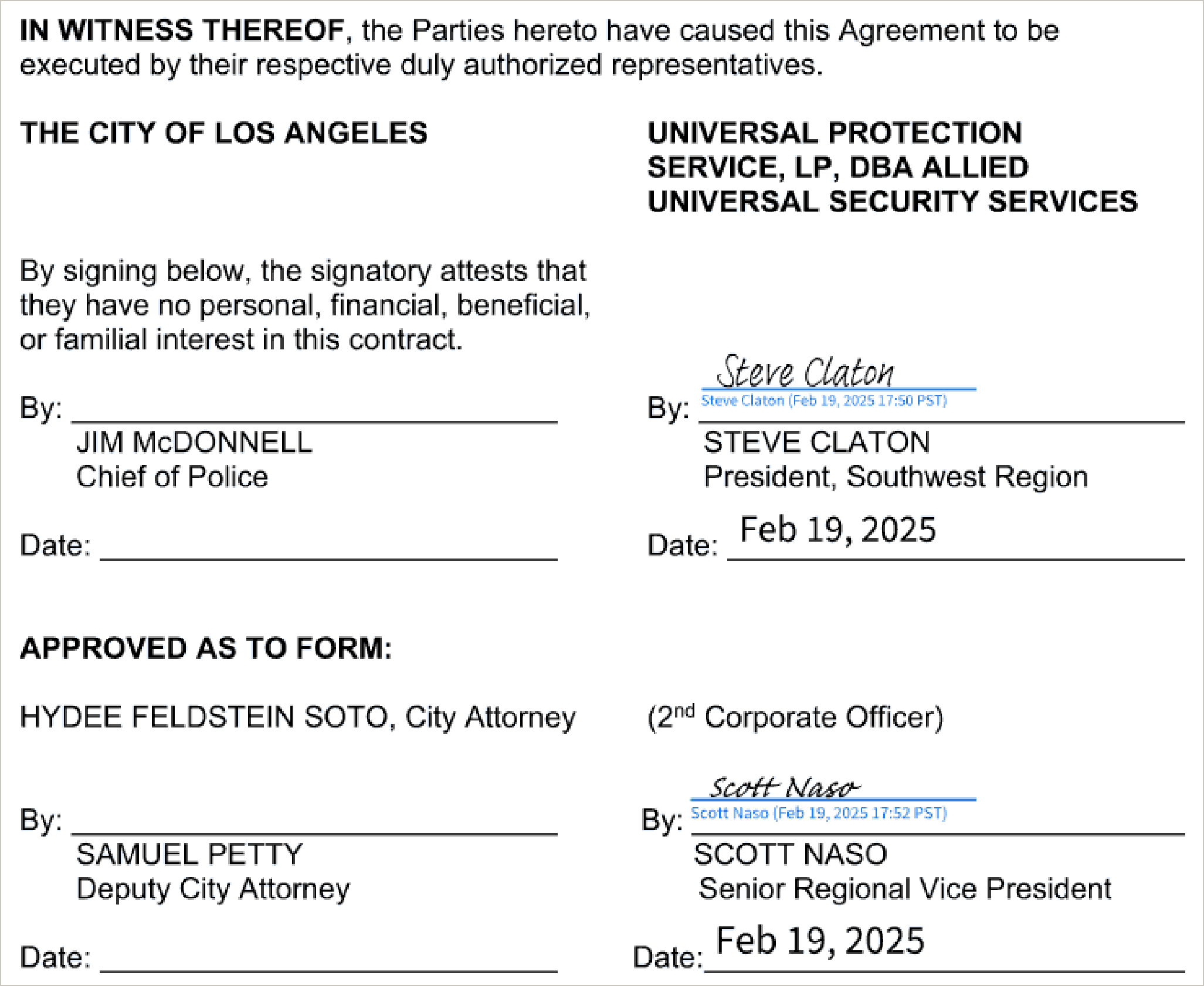
The city’s own contract with Allied is a public record, filed with the council. Agreement C-141552-1, between the city and “Universal Protection Service, LP, DBA Allied Universal Security Services,” was signed for the company on February 19, 2025, by Steve Claton, the president of its Southwest region, and Scott Naso, a senior regional vice president. It’s one of six contracts the Los Angeles Police Department manages for guards across city government, and more than 20 departments order guards through them. When the council approved the amended contracts on May 20, 2025, it raised the six companies’ combined ceiling from $10 million a year to $35 million, or $100 million over five years. The vote was 11 to 3, with Eunisses Hernandez, Ysabel Jurado and Hugo Soto-Martinez voting no.
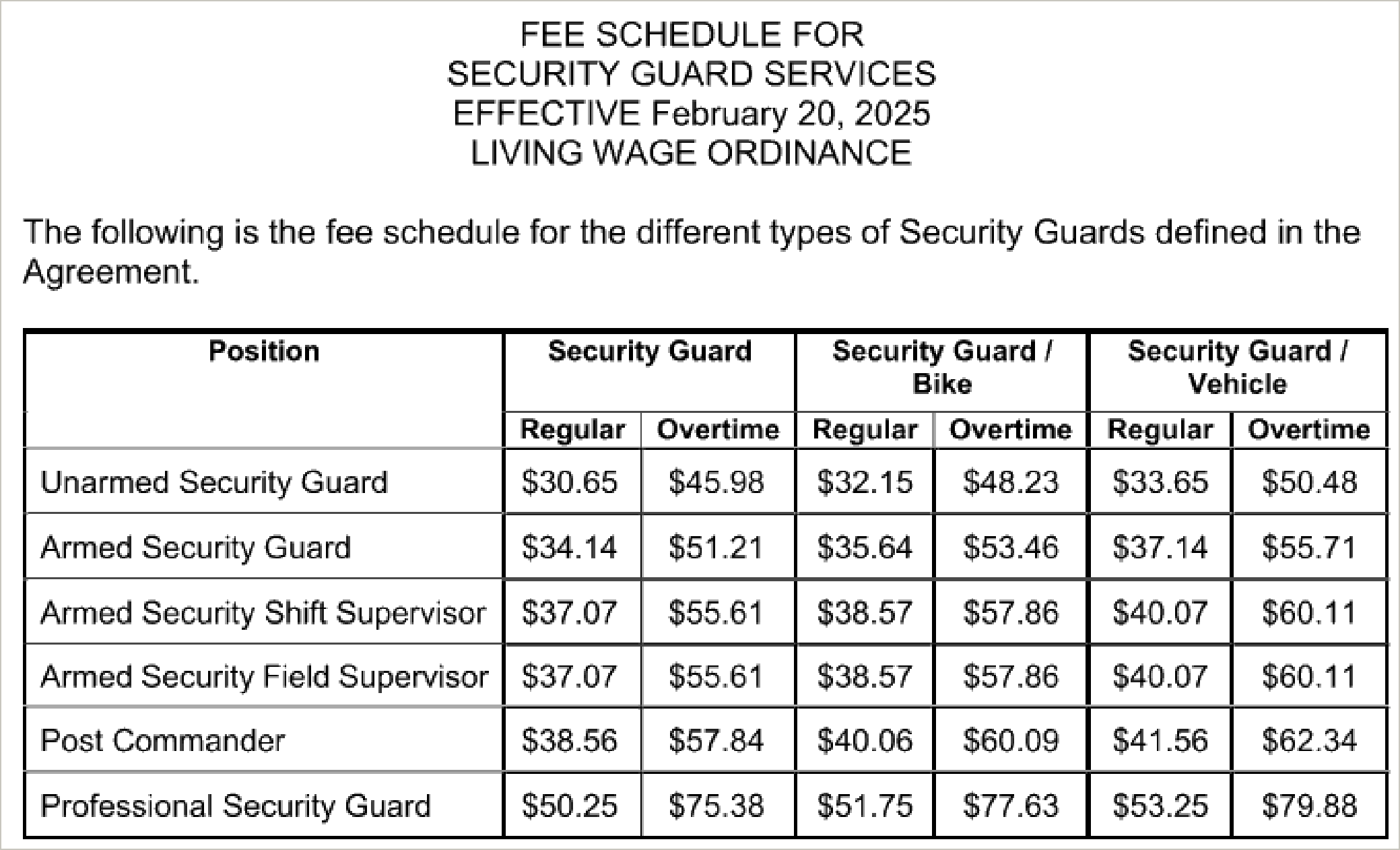
Allied bills the city by the hour. Under the fee schedule that took effect on February 20, 2025, the city pays $30.65 an hour for an unarmed guard and $34.14 for an armed one, and time and a half for overtime. Two guards working six hours a night at those rates cost between about $11,000 and $12,300 over a 30-day month, which is close to what Recreation and Parks has been billed for Runyon Canyon.
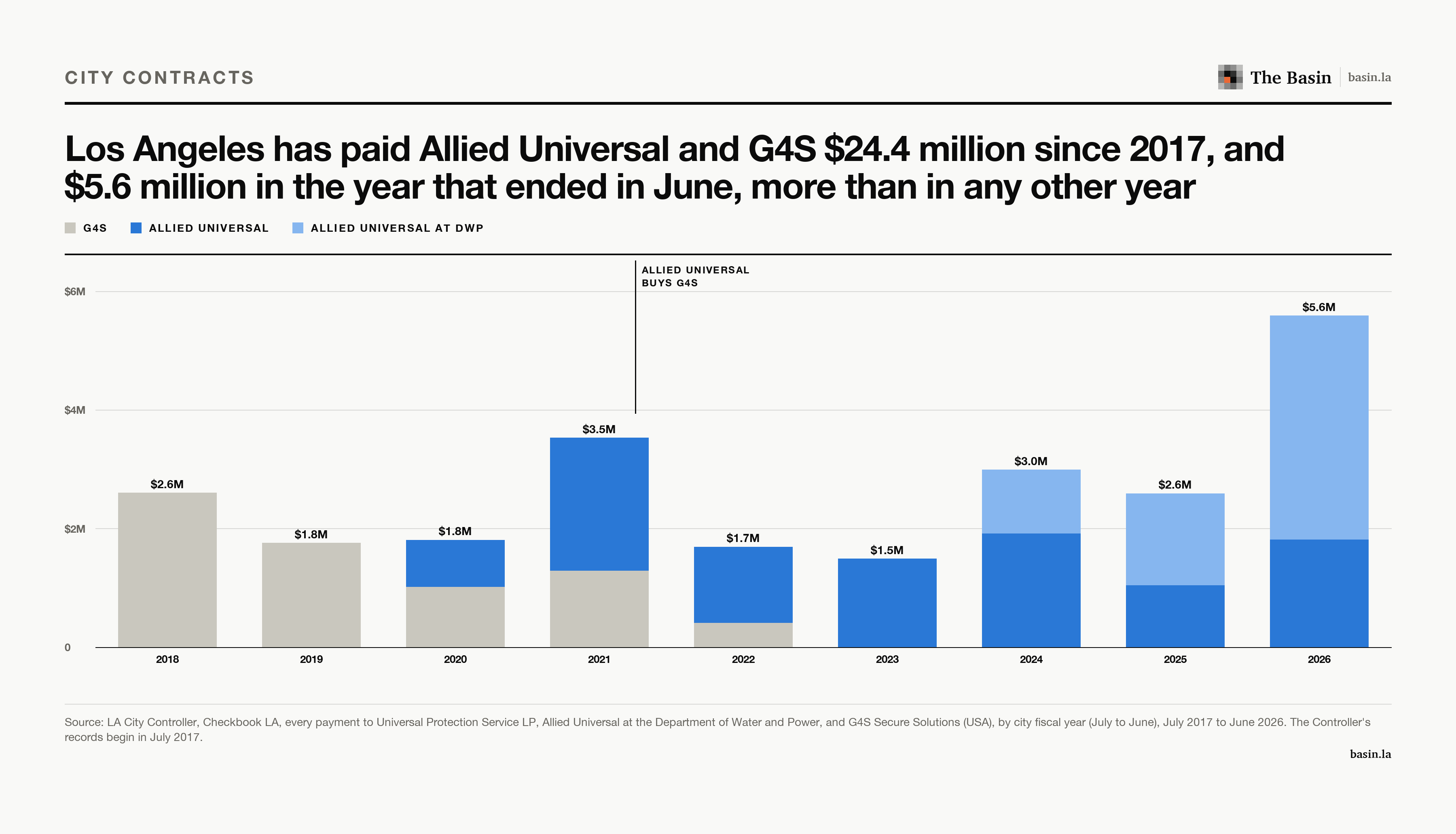
Allied has guarded city property for years, and G4S had its own police-managed guard contract with the city until 2022. Payment records from the City Controller, which begin in July 2017, show $24.4 million paid to the two companies since then, $15.6 million of it after Allied bought G4S. The year that ended in June was the biggest yet, at $5.6 million, largely because of DWP, which hires guards under a separate set of agreements that Allied shares with three other firms. On May 26, the Board of Water and Power Commissioners’ agenda carried an amendment to raise those agreements’ combined ceiling by $9.24 million, to $39.24 million.


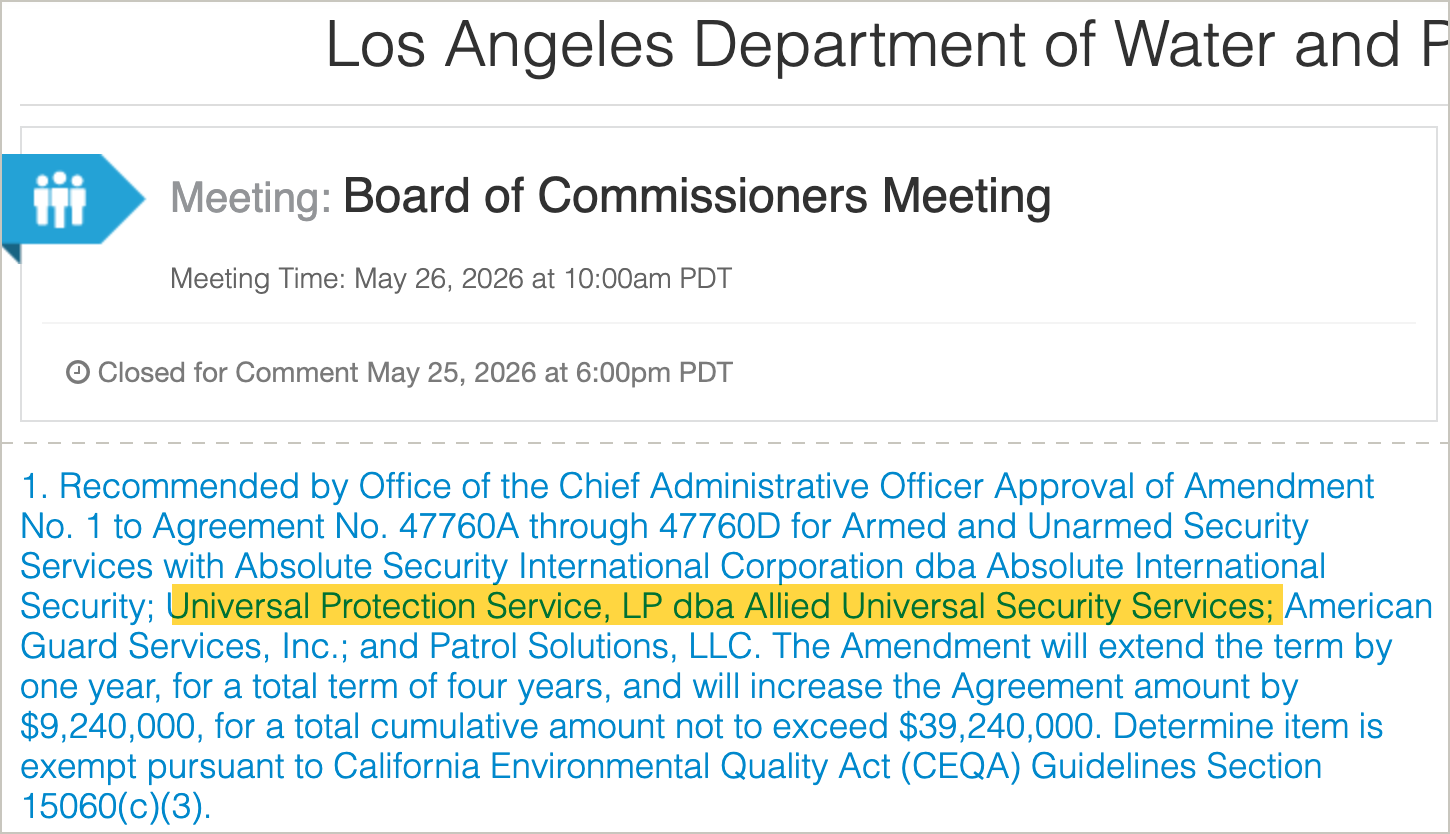
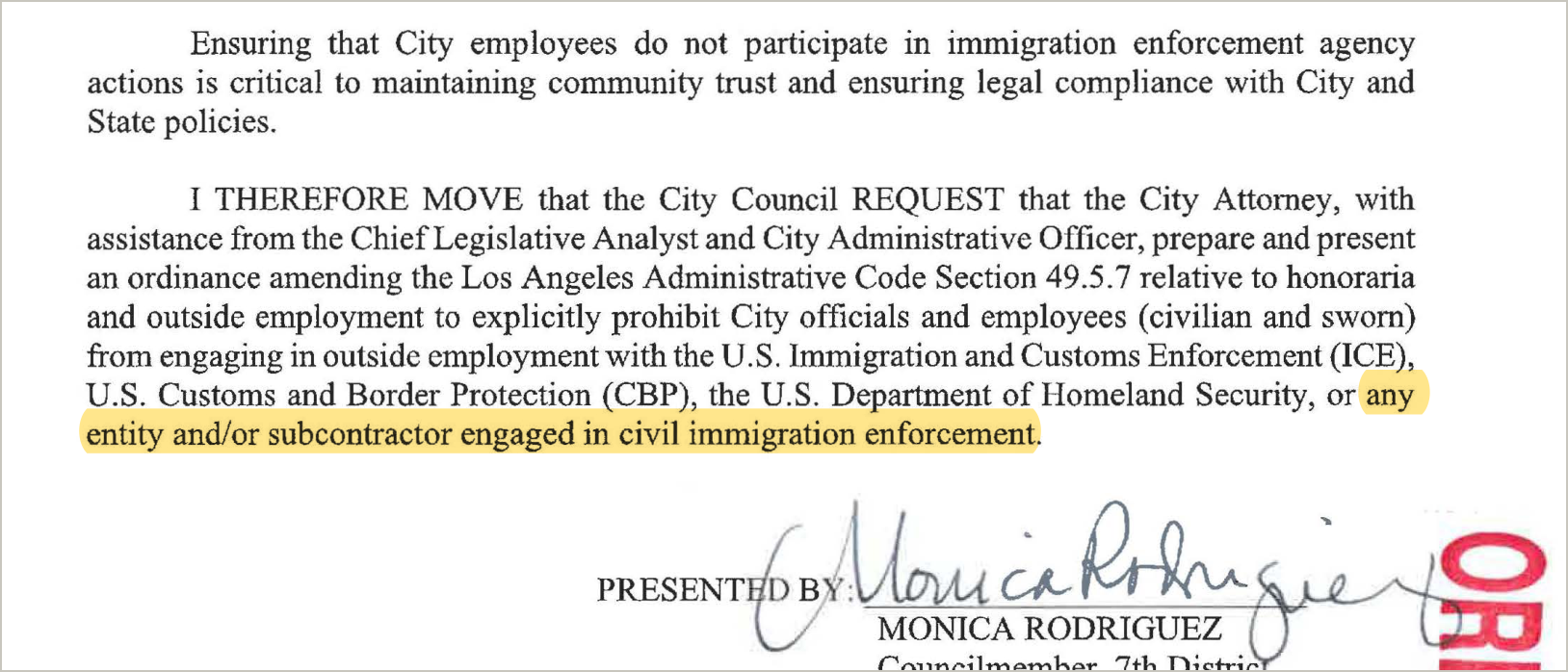
While those contracts were growing, the council was writing a rule about who city workers may work for. On August 27, 2025, Monica Rodriguez introduced a motion asking the city attorney to draft a ban on city employees taking outside jobs with ICE, Customs and Border Protection, the Department of Homeland Security “or any entity and/or subcontractor engaged in civil immigration enforcement.” The council passed the finished ordinance, No. 188903, on March 25 by a vote of 14 to 0, and it took effect on April 10.
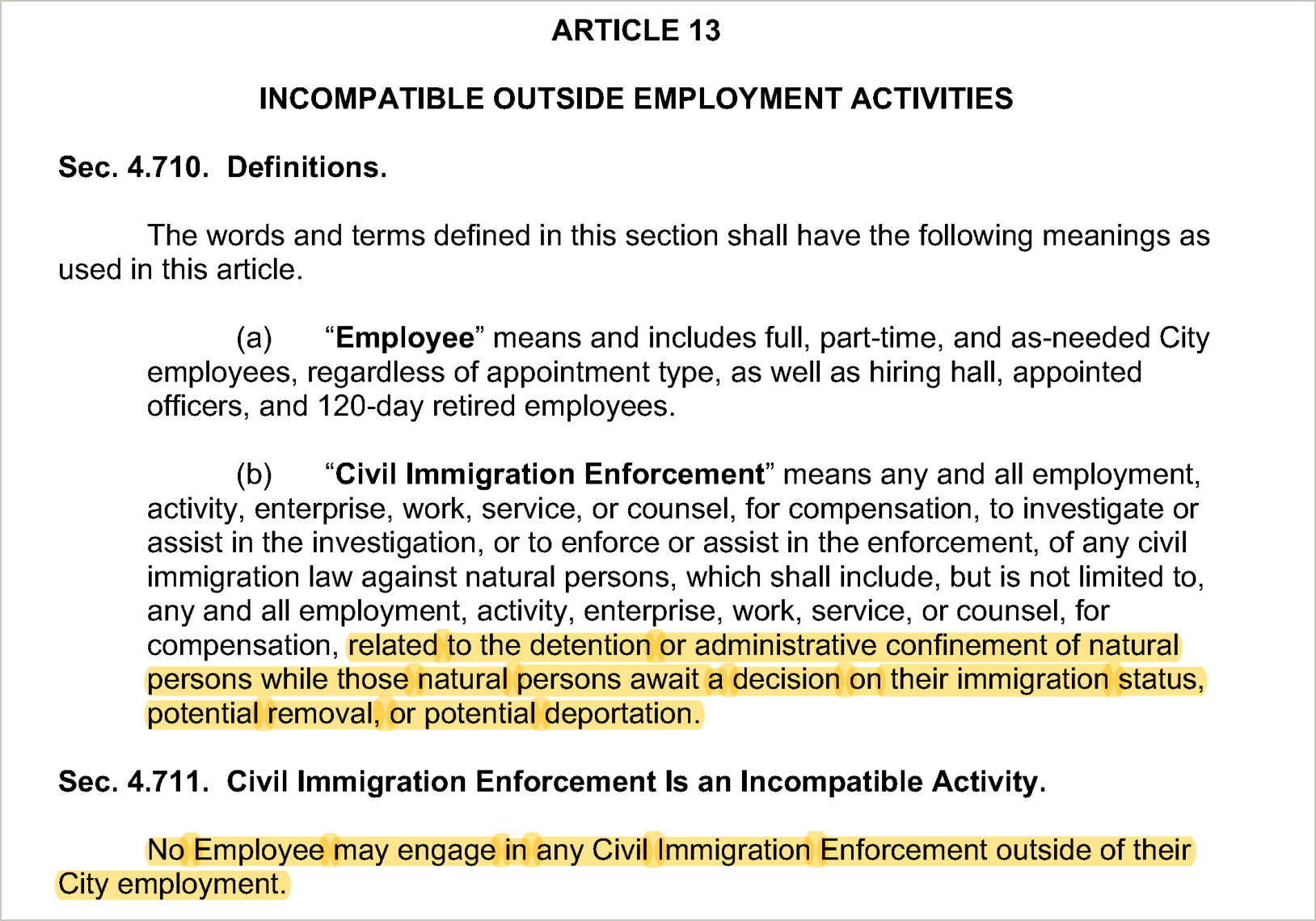
The ordinance defines civil immigration enforcement to include any paid work “related to the detention or administrative confinement of natural persons while those natural persons await a decision on their immigration status, potential removal, or potential deportation,” and says no city employee may do it outside their city job. Its findings say residents have mistaken police officers, social workers, firefighters and building inspectors for immigration agents since the raids began, and that the public’s trust “is further eroded when those City personnel engage in outside employment related to or in furtherance of these civil immigration enforcement activities.”
Nothing in the ordinance addresses the companies the city itself hires. Two days after it passed, Nithya Raman, whose district includes Runyon Canyon, and Curren Price introduced the motion to fund the park’s two night-shift officers, authorizing Recreation and Parks to make payments “to Allied Universal Security, or any other agency or organization, as appropriate.” The council adopted it on April 14, four days after the ordinance took effect, with all 15 members voting yes, Rodriguez among them, and Mayor Karen Bass approved it on April 24.