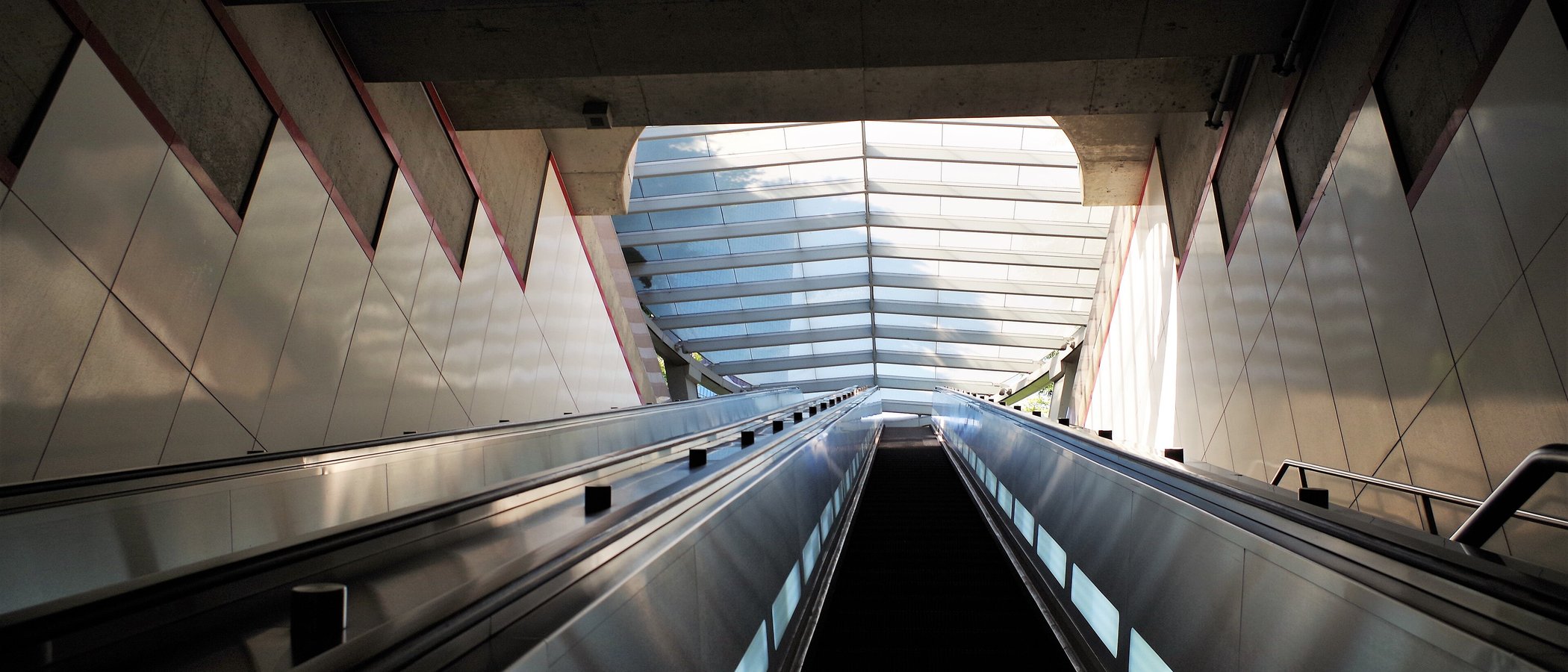

If you’ve ridden an escalator in Hong Kong or Singapore, the climb out of an LA Metro station can feel painfully slow. It’s really not just Metro though, American transit escalators generally operate under a much lower speed limit than those in much of the world.
Why? Well honestly we don’t have the whole answer, but we did look at the rules governing escalators in 139 cities across 58 countries and came to some interesting conclusions. One of them is that LA Metro runs below the maximum speed allowed in every single city on our list.
That doesn’t mean we measured 139 cities’ escalators. We compared their legal limits, which tell us how fast they’re allowed to go, and then looked separately at operating speeds where we could find them.
Escalator operating speeds, 42 cities
Hong Kong has some of the fastest escalators in the world, with most MTR station escalators moving people around at 0.75 meters per second, about 148 feet a minute. Next to LA’s specified 90 feet a minute, that’s about a 64% faster pace.
How fast the escalators run
For a climb the height of Civic Center/Grand Park’s platform-to-street ascent, that works out to about 87 seconds standing on an escalator in LA. A trip of the same length at Hong Kong’s usual speed would take about 53.
Civic Center’s Escalator Climb after 53 seconds
So if we could suddenly make LA’s escalators that fast, how much time would people actually get back?


Metro counts 115 stations and says it has 171 station escalators, but for this calculation we focused on the 27 underground stations. Using FY2026 station ridership figures circulated from a public-records response, we arrive at about 300,000 minutes of escalator riding on an average weekday, or about 1.7 million hours a year.
Modeled weekday escalator minutes
There are some pretty big assumptions here. We treated every underground station as roughly as deep as Civic Center and assumed everyone takes the escalator, standing still, both in and out. People obviously also walk, take the stairs or use elevators. Transfers complicate the ridership figures, and we left elevated stations out entirely, so this is a rough model rather than an actual count of everyone’s time.
But under those assumptions, matching Hong Kong’s usual speed would save about 119,000 minutes every weekday, or about 670,000 hours a year. For someone commuting between two underground stations every workday, the modeled saving is about 9.5 hours annually.
The problem is we can’t just turn them up.
Escalator operators choose their speeds within limits set by safety codes. Most of the cities we examined follow one of two main standards, or a national version of them. The European standard allows 0.75 meters per second at inclines up to 30 degrees. The American standard caps escalators at 100 feet a minute, about 0.508 meters per second. California uses that 100-foot limit for new installations and speed alterations.
Metro’s 90 is another 10% below that. LAX, meanwhile, specifies the full 100 feet a minute, so even within Los Angeles we have an airport escalator specification that’s 11% faster than the subway’s.
Getting Metro to that American maximum would save 10% of the riding time in our model, about 30,000 minutes each weekday.
What would it cost? We don’t have a reliable price for making that change across Metro’s system. Matching Hong Kong would be a bigger project still, involving both the code limit and whether the equipment could accommodate the higher speed.
And faster isn’t automatically better for every rider. Singapore’s transit engineers measured nearly twice as much step vibration at 0.75 meters per second as at 0.5. Their escalators use the faster setting during rush hour and the slower one off-peak.

Speed also has very real safety stakes, and that’s where our next dive into escalators is headed.
Still, the strangest thing we found was in LA’s own archives.
The original subway design rules required escalators capable of running at both 90 and 120 feet a minute. At 120, that Civic Center climb would take about 66 seconds instead of 87.
Metro's escalator rule
We don’t know whether the installed escalators ever actually ran at 120, or when and why that requirement disappeared. The American code lowered its maximum from 125 to 100 in 2000, but we haven’t established a connection between that change and Metro’s decision.
What we do know is that LA’s original subway planners required a faster option. Somewhere between those plans and the later rulebook, we lost it.