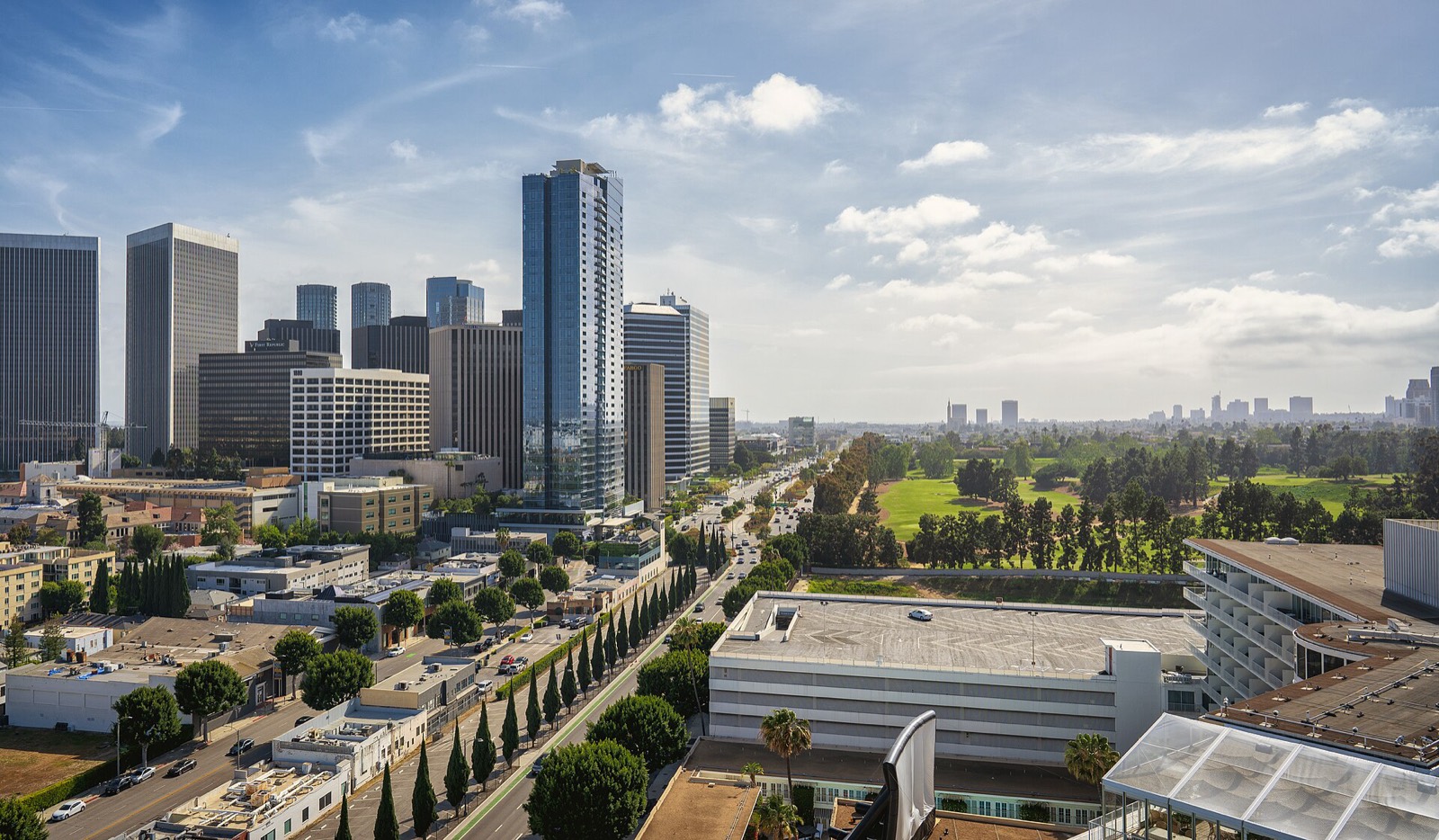

Last year Los Angeles ranked 93rd out of the 100 largest cities in the country on the Trust for Public Land’s ParkScore index, its seventh consecutive annual decline. That may come as a shock, since from the air LA looks at least a little bit green? The patches of green you’re thinking of may look like parks, but they are almost certainly not parks, and they are even less likely to be public. These are in all probability the city’s many sprawling private country clubs. The city’s own open-access parks cover about 11,600 acres, or 15,700 if you count Griffith Park, which is enormous and, for most Angelenos, relatively inaccessible.
Measured by council district, just one of these private golf clubs, the Los Angeles Country Club, covers more acreage than every public park in CD8, CD9 and CD10… Combined. The club is 308 acres. Those three districts have 73 parks between them, and they total 270 acres. Despite that footprint, these country clubs contribute very little to the city’s tax base. Per the county assessor, every private country club in Los Angeles combined is assessed at $317 million, which is very low for 1,896 acres in some of the most expensive parts of the city.
One golf club against fifteen park systems
City-managed, open-access park acreage by council district
The dashed line is the Los Angeles Country Club alone, at 308 acres.
Source: Basin Data, la-parks-by-district and la-golf-club-assessments. Acreage clipped to the city boundary; parks straddling a district line are counted in their primary district.Take the Los Angeles Country Club as one example. Its 308 acres are assessed at $24 million and it pays $285,533 a year in property tax. The Spelling Manor at 594 S Mapleton Drive, a single-family home on 4.6 acres a few hundred yards away and in the identical tax rate area, is assessed at $112.5 million and pays $1,335,802. The house sits on one and a half percent of the club’s land and pays four and a half times the tax. Across Santa Monica Boulevard, the Westfield Century City shopping center occupies about 40 acres, and the county assesses the land under it at $258 million. That figure covers the land alone. For tax purposes the 40 acres beneath Century City are worth $258 million, and the 308 acres of far more valuable land across the street are worth $18.7 million.
We put every golf course in the city on one scale, each with its acreage and its tax bill. Combine every private country club in Los Angeles into one club and three questions follow: how big it would be, what it would be “worth”, and what it would pay in tax.
First, how big would it be? We count 12 private country clubs inside the city. The largest is the Los Angeles Country Club at 308 acres and the smallest is Woodland Hills Country Club at 90, and together they sit on roughly 1,896 acres, which is about three square miles, a decent margin larger than the entire city of West Hollywood. It would be far and away the largest privately held stretch of land in Los Angeles.
Every private country club in Los Angeles, next to the city of West Hollywood
Both drawn to the same scale. The twelve clubs cover 1,896 acres; the entire city of West Hollywood covers 1,207.
West Hollywood is 36 percent smaller and pays 53 times the property tax. Club boundaries from OpenStreetMap, within 3 percent of assessor parcel acreage; values and rates from the county assessor and auditor-controller, FY 2025-26.What is it “worth”? On assessed value the mega club would rank only 86th among individual parcels in the city, slotting in between the ROW DTLA complex at 777 S Alameda Street and the office tower at 5200 Wilshire Boulevard. More preposterous still, the Los Angeles Country Club on its own is assessed below 330 single-family homes inside the city limits.
How much would it pay in taxes? This is where it gets a bit messy. There are two primary tax loopholes most of these clubs use.
First, Prop 13. Prop 13 rolled back property taxes in California to 1975 levels, capping growth at 2% per year until a property changes ownership. In 1975 the Los Angeles Country Club’s land was established to be worth $2.3 million, and after fifty-one years of compounding it’s now worth $5.7 million.
Second, a 1960 amendment to the California Constitution requiring that any nonprofit golf course of ten acres or more be assessed on its use as a golf course rather than on what the land underneath is actually worth. It still sits in the state constitution as Article XIII, Section 10, and it means that even if a club somehow triggered reassessment tomorrow, the assessor would be constitutionally forbidden from valuing the land as anything but a set of largely empty grass lawns.
In 1982 this second strategy was tested when the county assessor reassessed the clubs and thirteen of them took him to court. The clubs won, the courts confirmed they get both protections at once, and that’s how things stand to this day.
Only seven of the twelve clubs use the nonprofit golf-course provision. The other five, including Riviera, are for-profit operations, and when they changed hands the county reassessed them properly at market value. Riviera alone, on 168 acres, now pays more property tax than the seven nonprofit clubs combined. Woodland Hills made the same point the hard way. It was a member-owned club until it sold in 2020, and the assessor marked it to market within a single lien date of the nonprofit use ending. In other words the machinery works fine, right up until it reaches the carve-out.
What an acre is worth on the county books
Assessed land value per acre for the twelve private clubs, current roll.
Today the seven sheltered clubs pay $1.4 million a year between them. If we repeal Prop 13 tomorrow, the constitution still forces the assessor to value them as golf courses, which nets you roughly $2.2 million, better but still unreasonable. Repeal the 1960 carve-out, though, and value the land the way the county values every other piece of land, and the seven remaining nonprofit clubs are sitting on somewhere between $2 billion and $6.7 billion of land.
Three answers to the same question
Annual property tax on the seven sheltered clubs under each scenario, against what the city of West Hollywood, on a smaller footprint, actually pays.
Whatever the right number is, it is not $1.4 million. A city that ranks 93rd in the country for park space is assessing three square miles of its most exclusive land at 1975 prices, and collecting $1.4 million a year for it.
None of it is cheating. The rules were written this way on purpose, once in 1960 and again in 1978.