
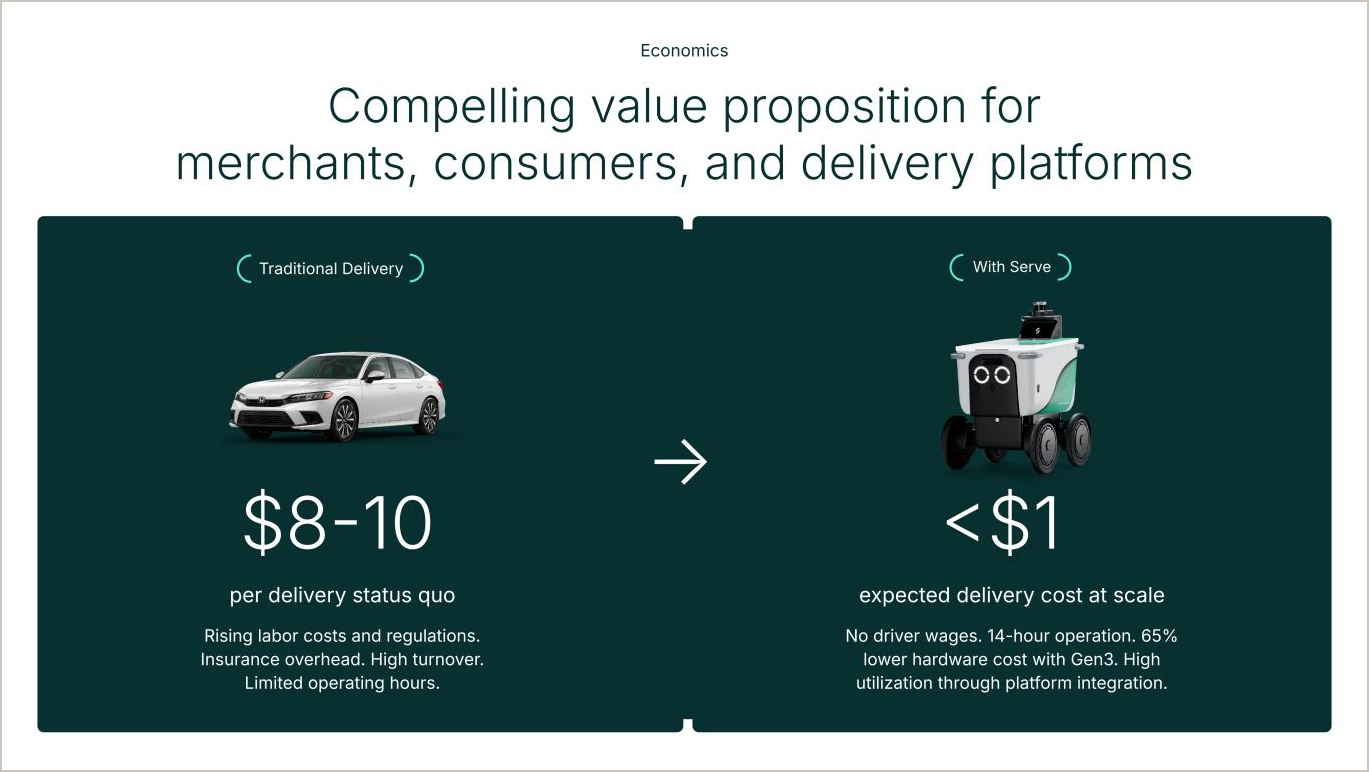
In October, Serve Robotics showed investors a slide with a white sedan on one side and one of its sidewalk robots on the other. Under the car, the presentation puts the cost of a delivery by a human courier at “$8-10” and blames “Rising labor costs and regulations” and “High turnover.” Under the robot, it projects a cost of less than $1 a delivery “at scale,” and the first advantage it lists is “No driver wages.” The slide’s title calls this a “Compelling value proposition for merchants, consumers, and delivery platforms,” meaning the restaurants, their customers and apps like Uber Eats and DoorDash that send Serve its orders.

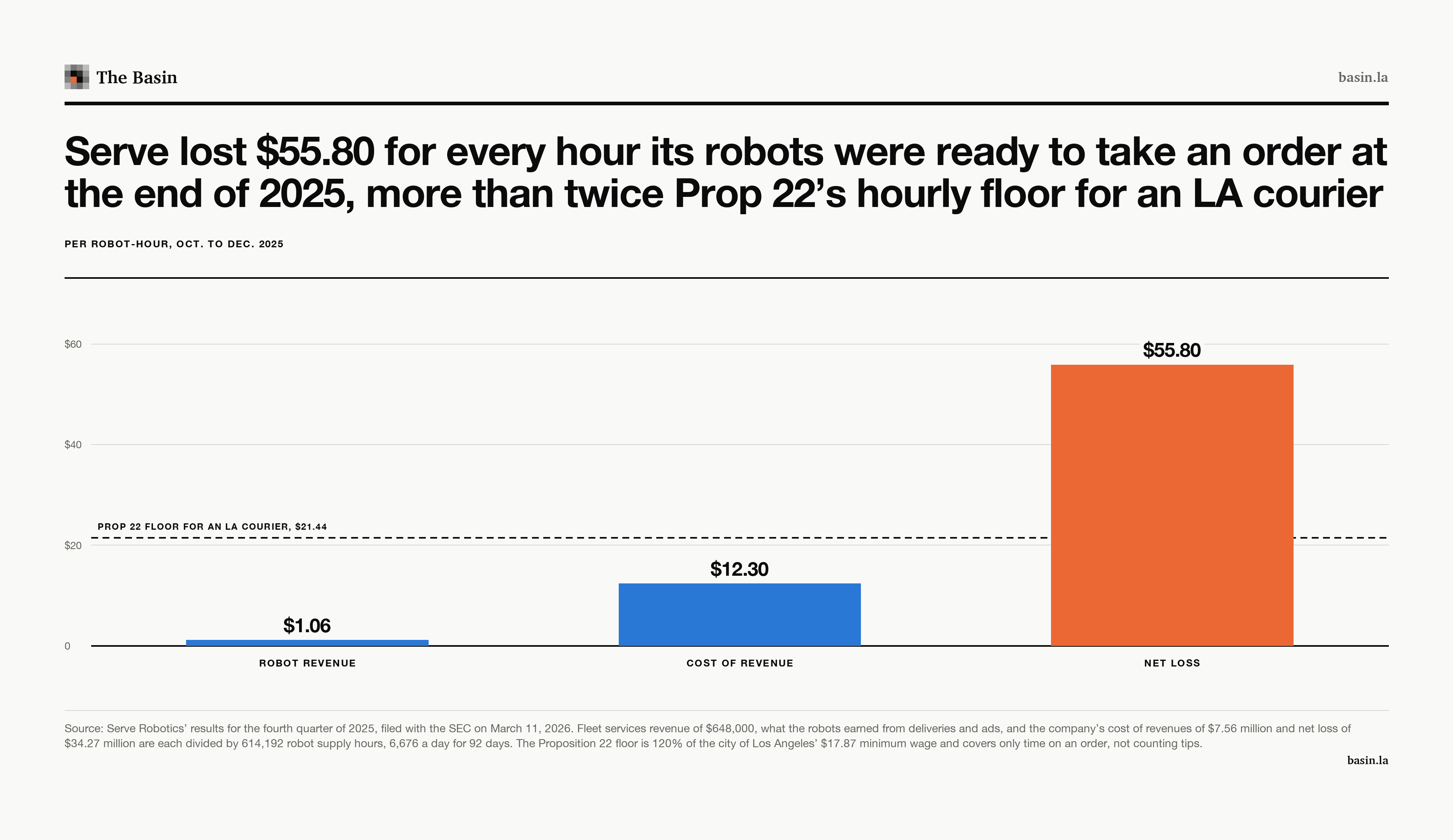
Serve runs more delivery robots in Los Angeles than any other company, more than 500 by the Los Angeles Times’s count, but it reports its finances for the whole fleet. In the last three months of 2025, its robots across the country were available to take orders for 614,192 hours, according to its quarterly results. They brought in $648,000 from deliveries and the ads wrapped around them, about $1.06 an hour. Serve’s cost of revenue, which also covers a small software business, was $7.6 million, or $12.30 an hour, and with research and overhead added it lost $34.3 million in the quarter, which is $55.80 for every hour a robot was ready to work. For 2025 as a whole it lost $101.4 million on $2.7 million in revenue and raised $261 million from investors, its annual report shows.
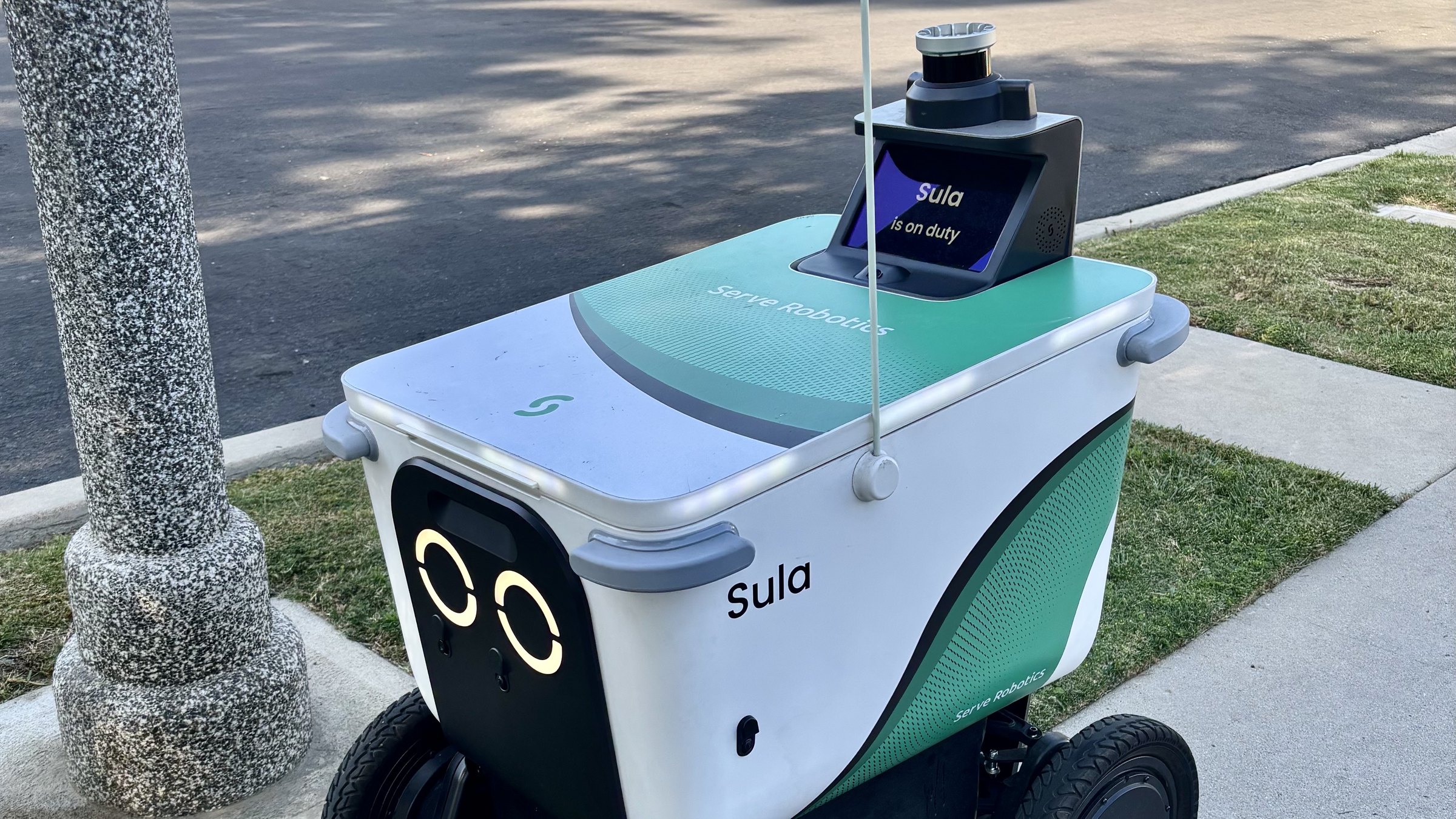
Proposition 22, the 2020 ballot measure that keeps app couriers classified as independent contractors, guarantees a courier 120% of the local minimum wage, and only for time spent on an order. For a pickup in the city of Los Angeles that came to $21.44 an hour at the end of 2025, and “Tips don’t count toward your guaranteed earnings,” DoorDash’s guide for California drivers says. Serve’s loss for each robot-hour was more than two and a half times that floor, and those robot-hours include time spent waiting for an order, which Prop 22 doesn’t pay a courier for.


Delivery workers in Los Angeles and the Bay Area netted a median $5.93 an hour after expenses and before tips in January 2022, the UC Berkeley Labor Center found. Serve’s annual report lists the push to give those workers more protection among the reasons it expects robot delivery to catch on. It names “regulatory pressures to classify gig workers as employees, which would in turn increase labor costs” as one reason last-mile delivery stays expensive, then tells investors that “Labor cost inflation and regulatory pressures serve as tailwinds that are expected to accelerate the adoption of automated robotic last-mile delivery.”
Ali Kashani, Serve’s chief executive, was blunter with Spectrum News in May. “You don’t have to tip the robots,” he said. “So that’s a big cost factor that actually is prohibitive.” He also said people are still needed for big orders, long trips and deliveries into office and apartment buildings, and Spectrum described the robots as a supplement to drivers, not a replacement.
Serve still pays people to keep the robots running. Its “robot wranglers,” some of them former gig drivers, earn $24 to $26 an hour charging, cleaning and rescuing robots from a West Hollywood warehouse, the Times reported in March. Some of the remote piloting is done by outside vendors, including “service centers outside of the United States,” according to the annual report, which also says Serve agreed in December 2025 to pay $375,000 to settle a class action accusing it of violating the California Labor Code. The filing doesn’t describe the claims.
LADOT hasn’t published a count of robot trips in Los Angeles, and Serve doesn’t report its deliveries, so there’s no public measure of what the robots have done to courier work. West Hollywood, which requires Serve and Coco to share trip data, counted more than 34,000 robot trips there from January to June 2025, about 180 a day, in a staff report last December, and its emissions estimate assumed only 5% to 15% of them replaced a delivery by car. Across Los Angeles County, the Census Bureau counted 48,376 self-employed couriers and messengers in 2024, a category that also includes parcel and grocery drivers.
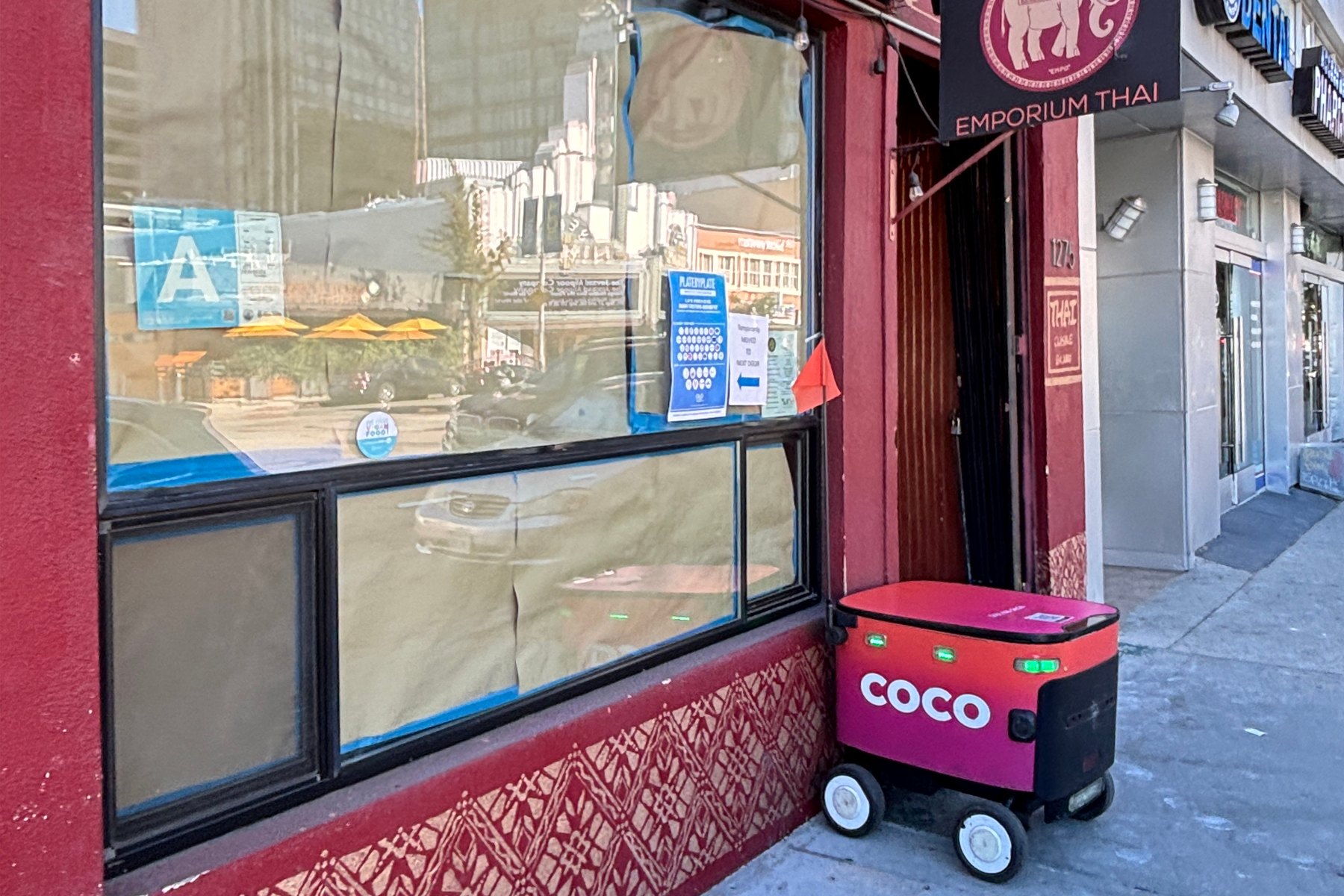
Julia Roggiero, who delivers mostly in West Hollywood and Silver Lake, told the Times in July 2025 that she used to get five or six requests an hour, and that in Santa Monica or Venice “it takes me an hour to get one or two, maximum three.” “They do deliveries that we can do, so they are taking our income,” she said. Zach Rash, a co-founder of Coco, the other big operator in Los Angeles, told the paper its robots take the shortest trips, and Serve’s own presentation says “two-thirds of delivery orders in our operating areas can’t be served by robots today.”

Uber, which spun Serve off from Postmates in 2021, has been pulling away. In August, Serve cut its 2026 revenue forecast from about $26 million to between $9 million and $10 million, citing “lower than expected delivery volume through the Company’s Uber Eats partnership” in its second-quarter results. On a call with analysts, Kashani said the companies had “differing views” about running a shared robot fleet and that Serve didn’t expect to renew its Uber agreement when it ends in early 2027. Uber had sold all of its Serve shares by the end of June, its holdings report shows, while Serve’s revenue from DoorDash grew almost 50% that quarter.
Robots run on the city’s sidewalks under a 2021 LADOT permit that charges $10,000 a year for up to 50 of them and $20,000 for more, with no fee for advertising, though ads made up nearly half of Serve’s food delivery revenue in the second quarter. West Hollywood’s staff, told that ad space on a robot was worth $22.85 a day, proposed charging operators $6. The Los Angeles City Council asked LADOT in November 2025 to review the city’s fees, and the council file shows no answer from the department yet.