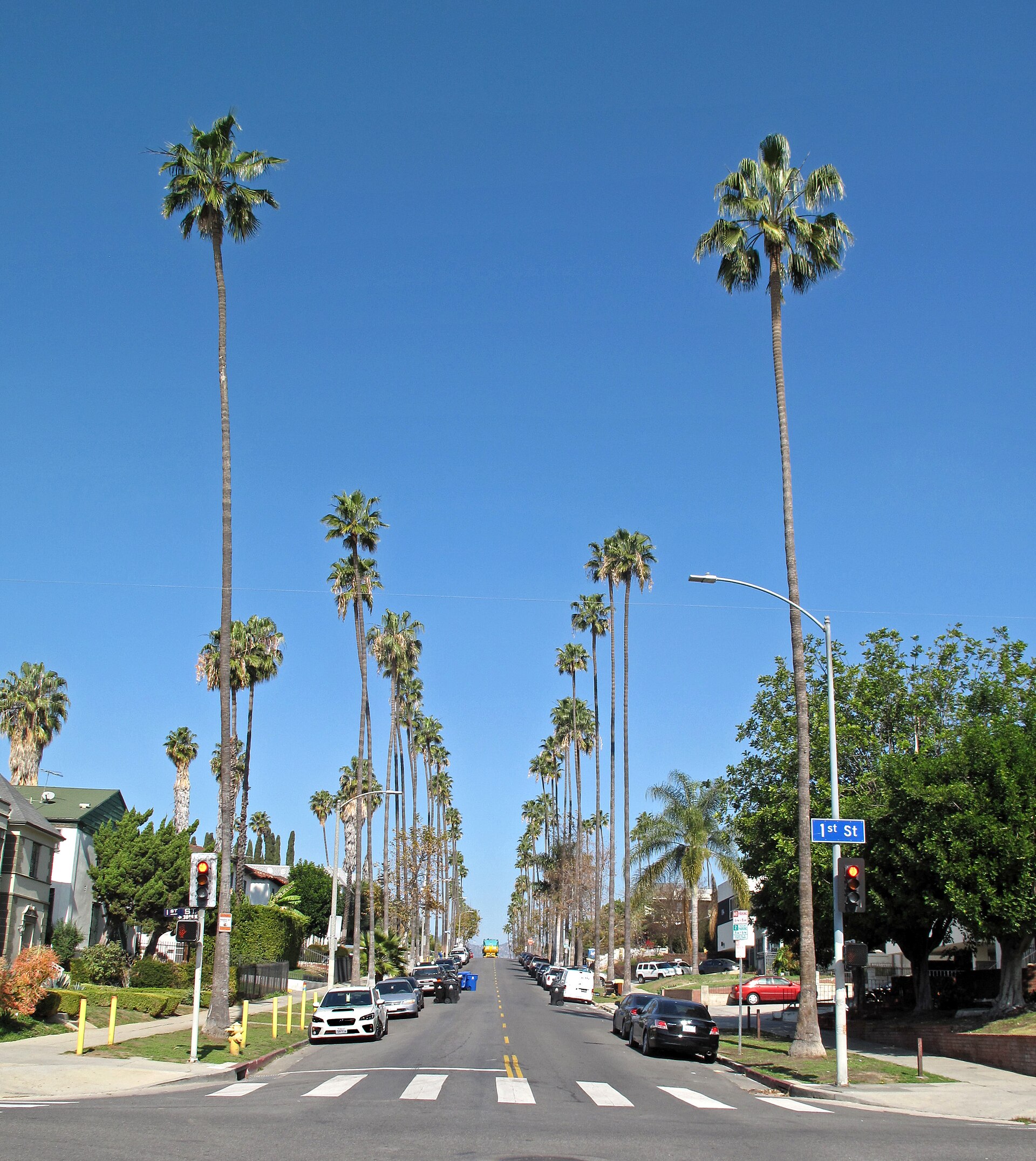

Los Angeles finished counting its street trees in 2023, the first full count since 1996 according to the City Controller. Arborists from Davey Resource Group walked the public right of way between 2020 and 2023 and logged every tree, stump and vacant planting site into a file the Bureau of Street Services now keeps live. It holds 883,649 records, and 661,600 of them are living trees of a named species.
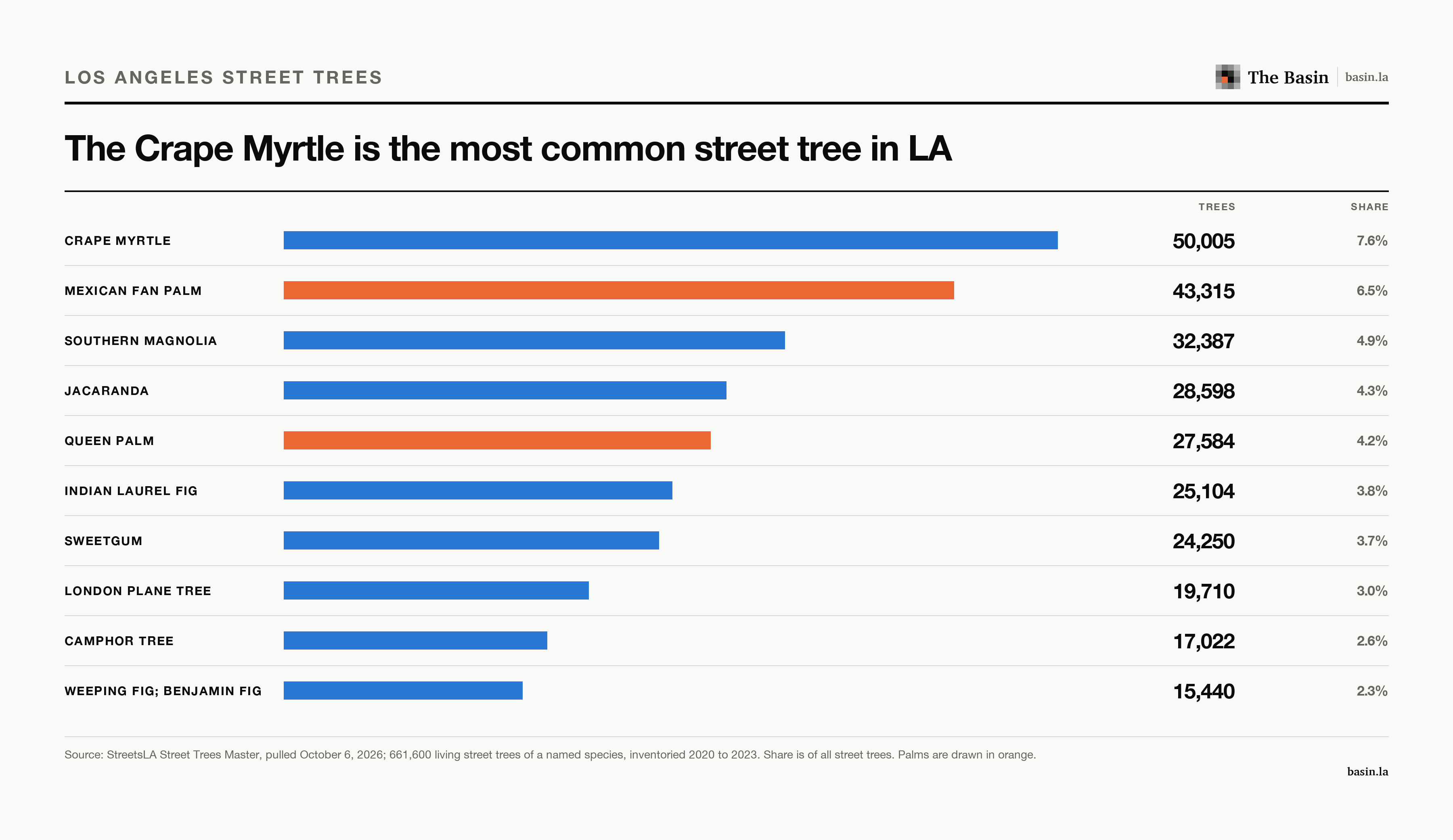
94,767 of those trees are palms, about one street tree in seven. The Mexican fan palm alone accounts for 43,315, the second most common street tree in the city behind the crape myrtle, a small flowering tree from Asia that the inventory counts 50,005 times. The queen palm is fifth with 27,584.
Palms are most of the tallest trees. The arborists sorted every tree into four height bands and put 31,752 street trees above 60 feet. 19,921 of them are palms, nearly two in three, and most of those are the Mexican fan palm, the tall, thin-trunked palm of the skyline shots.


The 1931 palms
Beginning in March 1931, the city put 400 unemployed men to work planting trees along 150 miles of boulevards, a $100,000 program paid for out of a $5 million unemployment relief bond, according to the historian Nathan Masters, who told the story for KCET in 2011. The forestry division planted more than 25,000 palms that year alone. Mexican fan palms cost $3.60 each and went in 40 to 50 feet apart. Masters writes that the program was unemployment relief first and Olympic beautification second, whatever the 1932 Games did for its reputation.
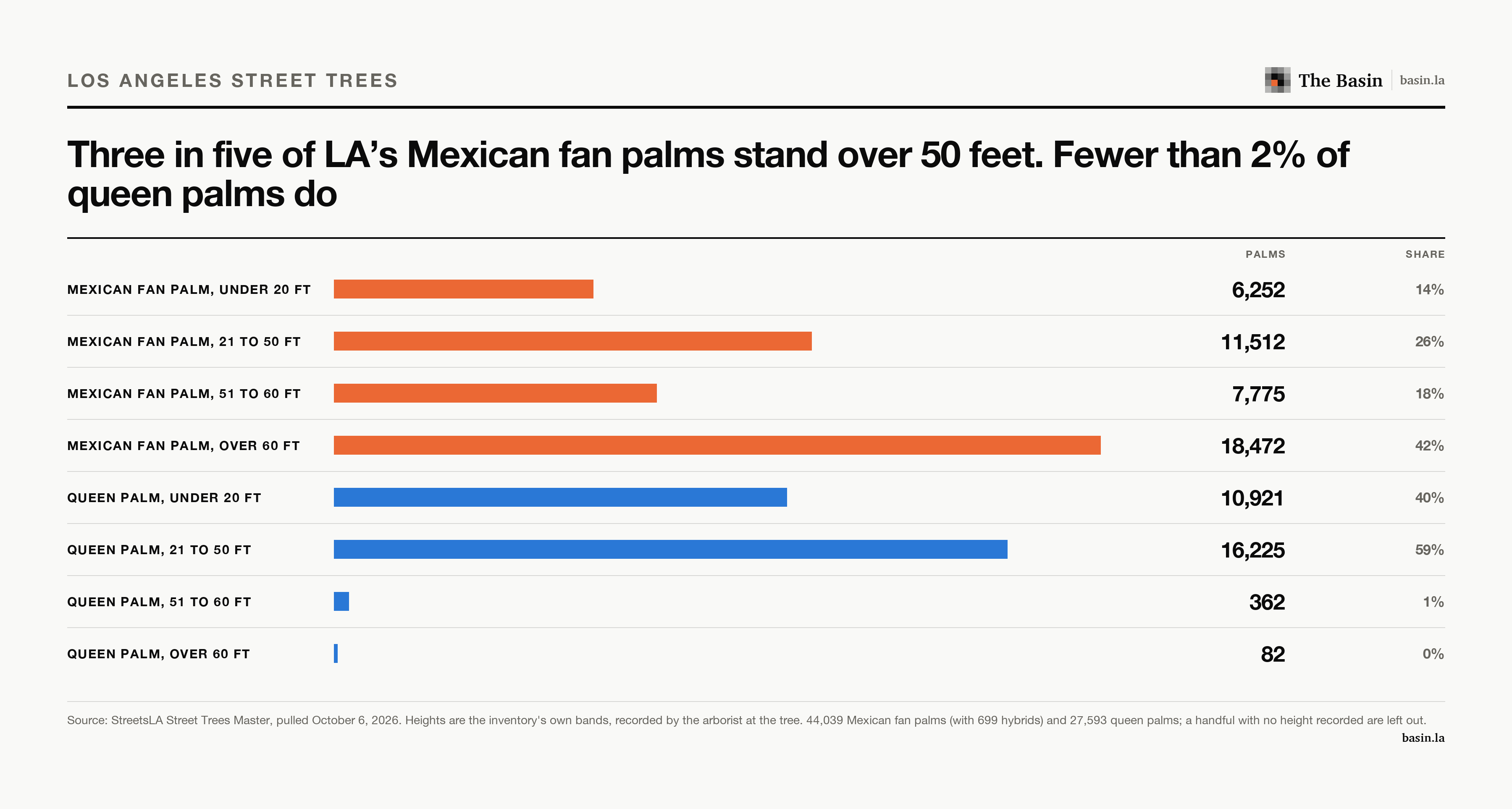
UCLA’s botanical garden describes those plantings as the source of the tall palms that dominate the skyline today, and says many are approaching the 100-year mark and perhaps the end of their natural lifespan. The inventory records heights but not ages. Of the 44,039 Mexican fan palms and hybrids in the file, the arborists put 26,247 over 50 feet and 18,472 over 60. The queen palm, a shorter species, barely reaches that band at all, with 444 over 50 feet.


Where the palms are
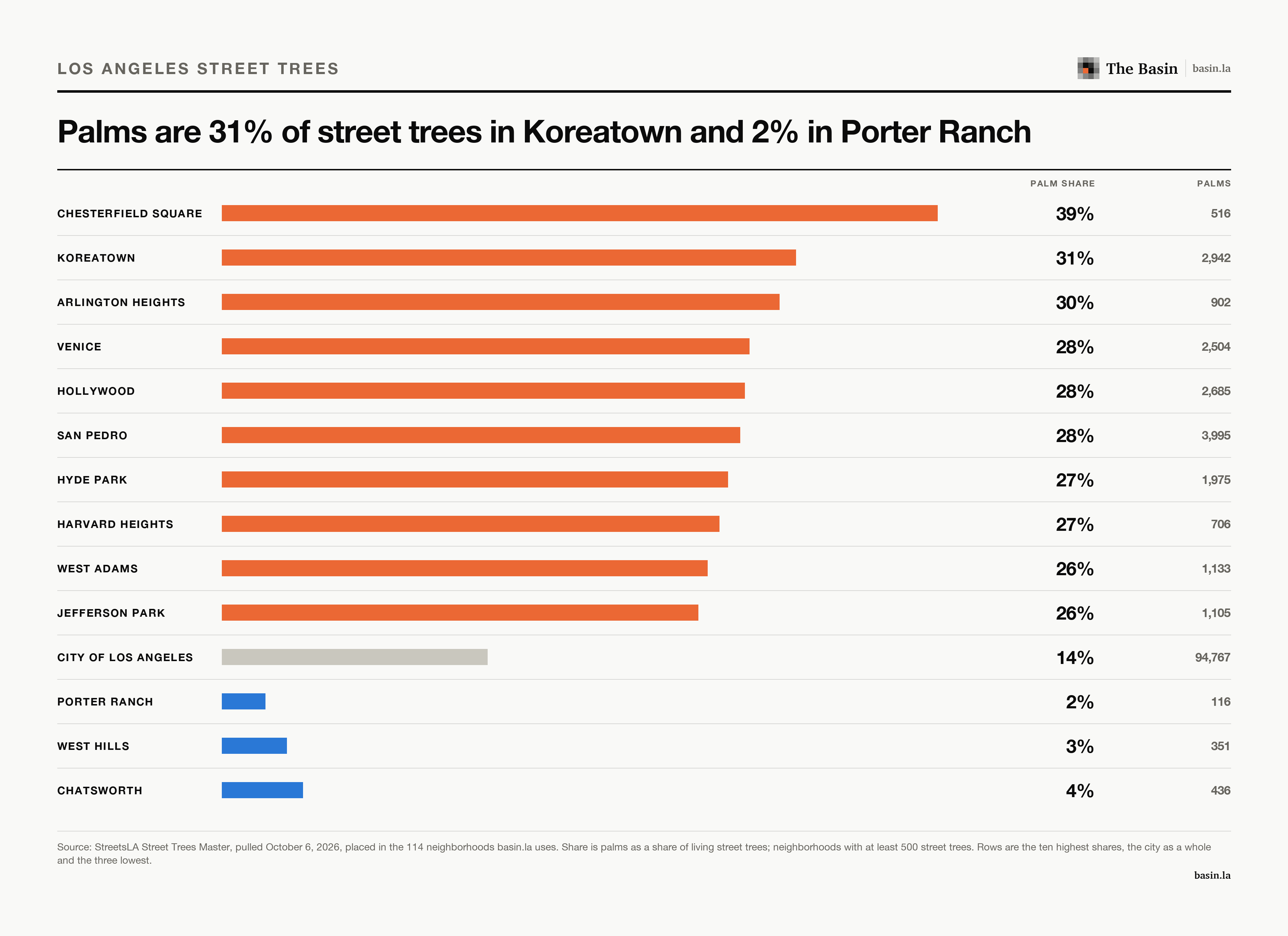
Koreatown has the densest palms in Los Angeles, 2,942 of them in 2.7 square miles, and nearly a third of its street trees are palms. San Pedro has the most in absolute terms, 3,995, followed by Koreatown, Pacoima and Hollywood. Chesterfield Square in South LA has the highest share, 516 of 1,340 street trees, or 39%. At the other end of the city, Porter Ranch has 116 palms among 4,977 street trees, and West Hills and Chatsworth are at 3 and 4%. By council district the 10th, 15th, 13th and 8th lead at 21 or 22%, and the 12th is at 5%.


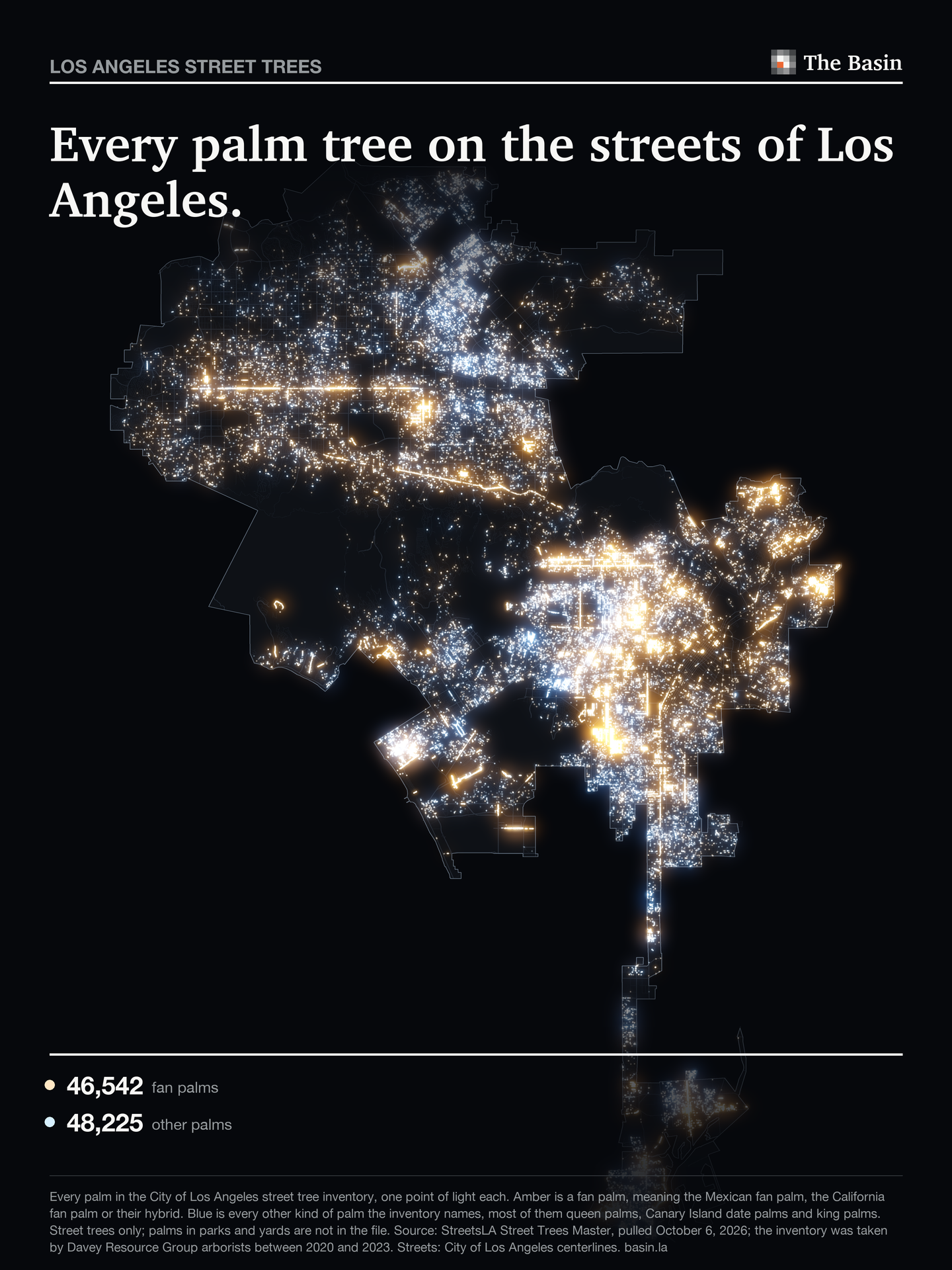
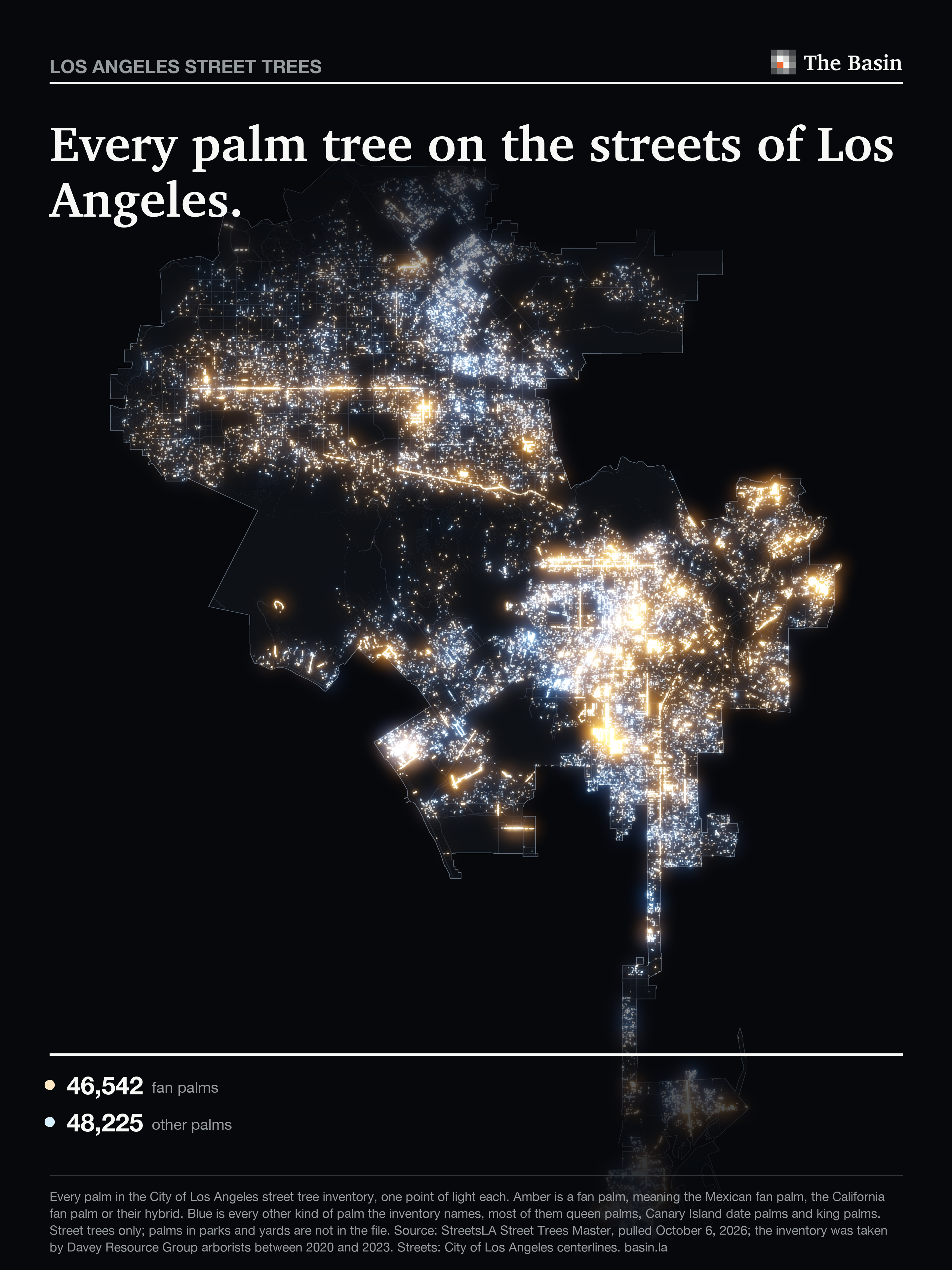
Fan palms cluster along the old boulevards of South Los Angeles, Hollywood and Mid-City and in long rows up the Valley’s arterials. The queen, date and king palms sit on residential streets in the central Valley and the Harbor. San Diego’s inventory, 90% complete in 2023, puts the queen palm and the Mexican fan palm at a fifth of its street trees, against 10.7% in Los Angeles.
The replacement policy
In 2006 the city’s tree program dropped palms. That October, as Mayor Antonio Villaraigosa’s Million Trees LA program got under way, the Associated Press reported that Los Angeles would replace dying palms with native oaks and sycamores rather than new palms. Paula Daniels, then a public works commissioner leading the planting effort, said palms “don’t provide the same benefits as the other, more leafy trees,” and the program’s list of nearly 60 approved varieties left them off. Officials said at the time they had no count of the city’s palms.
Since then the figure that has circulated, 75,000 street palms, has been a 1990 city tally that the Los Angeles Times cited in 2017, when officials said the number had since fallen and that they had no current count. The inventory supplies a count, and how it compares depends on what the 1990 tally included, which the record doesn’t say. If it counted every kind of palm, the city has more now, 94,767. If it counted only the fan palms that line the boulevards, it has fewer, 46,542.
The 2021 approved street tree list TreePeople posted still includes the Mexican fan palm and the California fan palm. Planting dates aren’t in the file, so it can’t say when any tree went in, but it holds 7,887 king palms, three quarters of them under 20 feet tall.
The empty sites
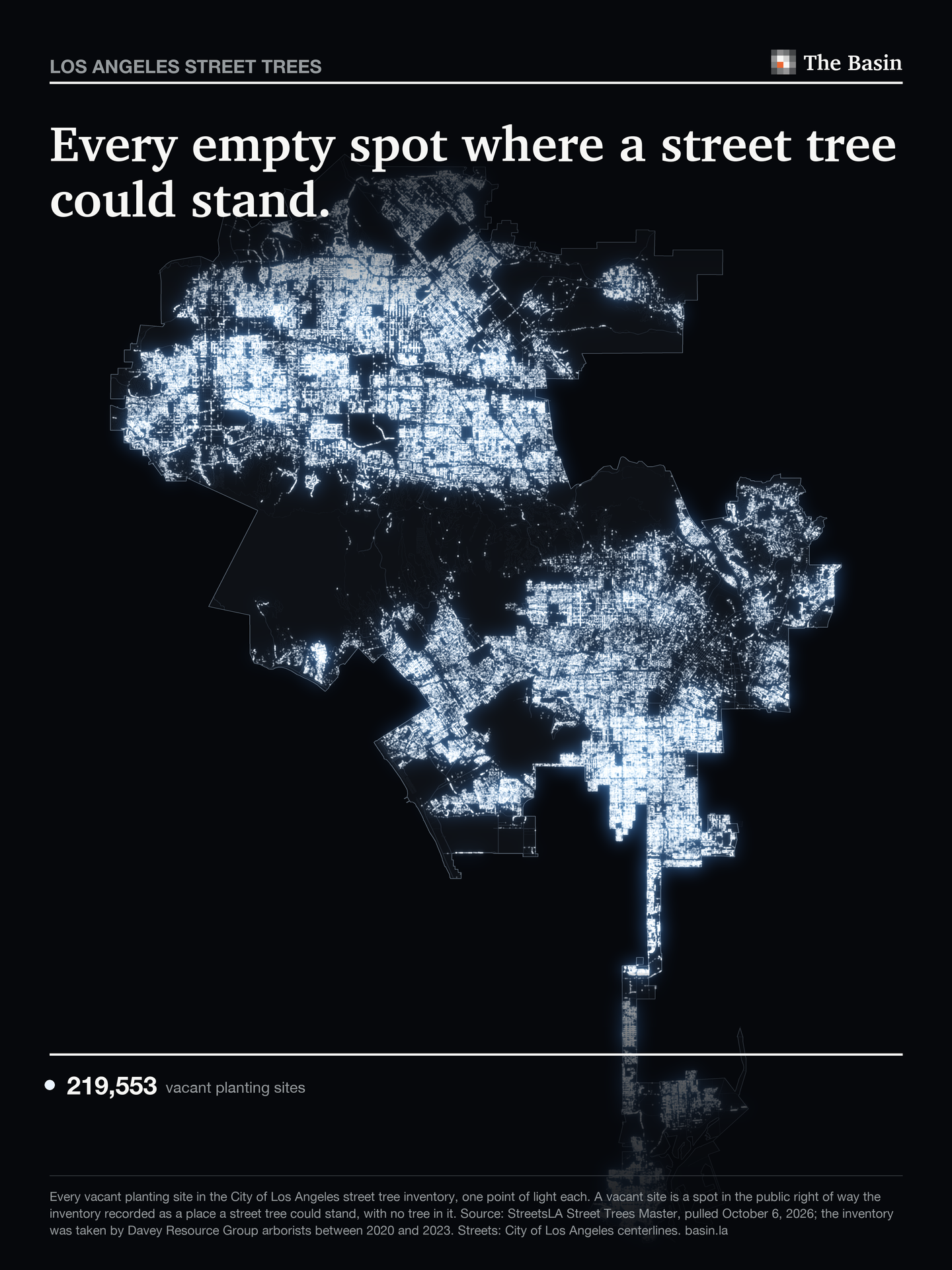
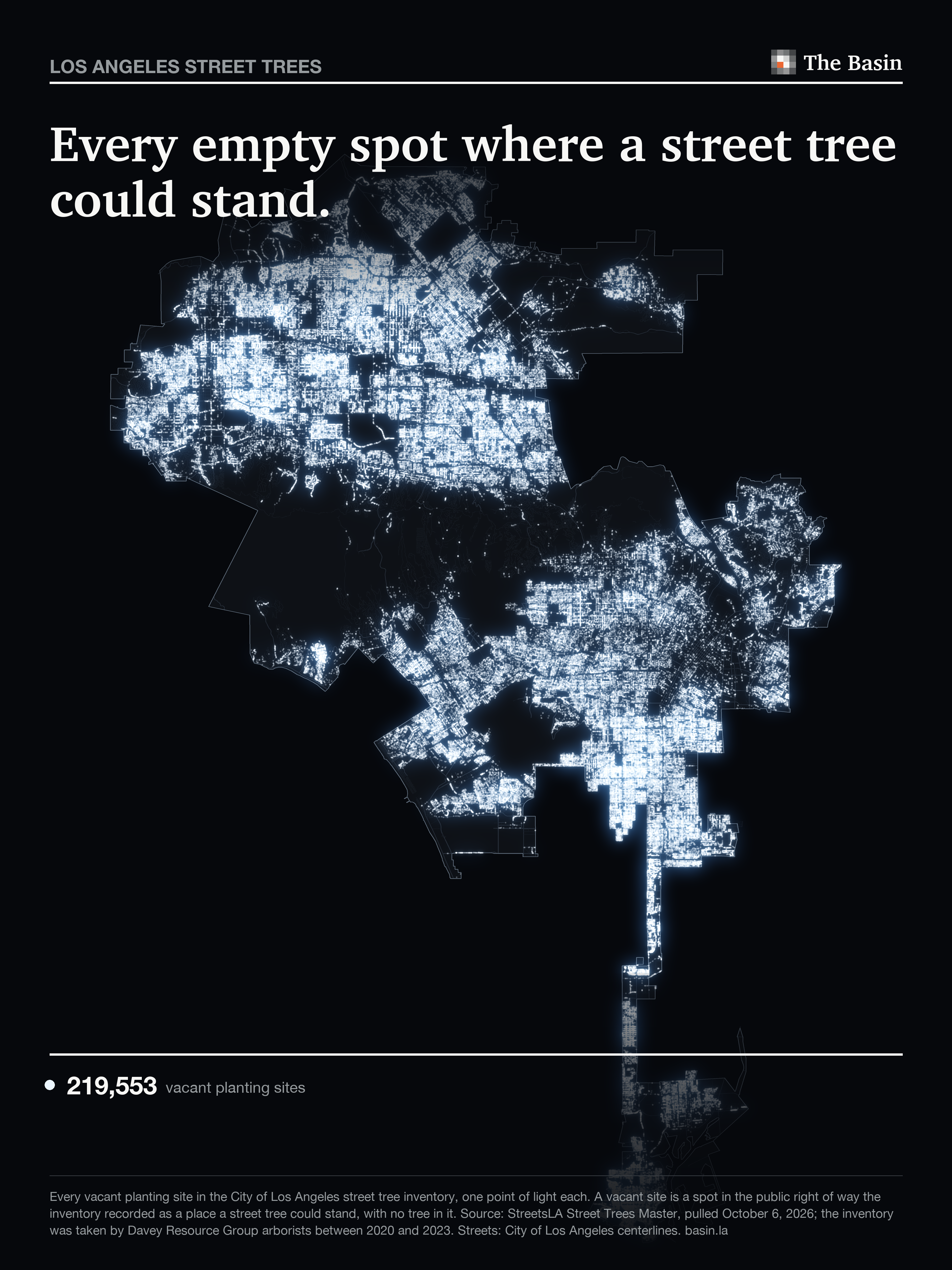
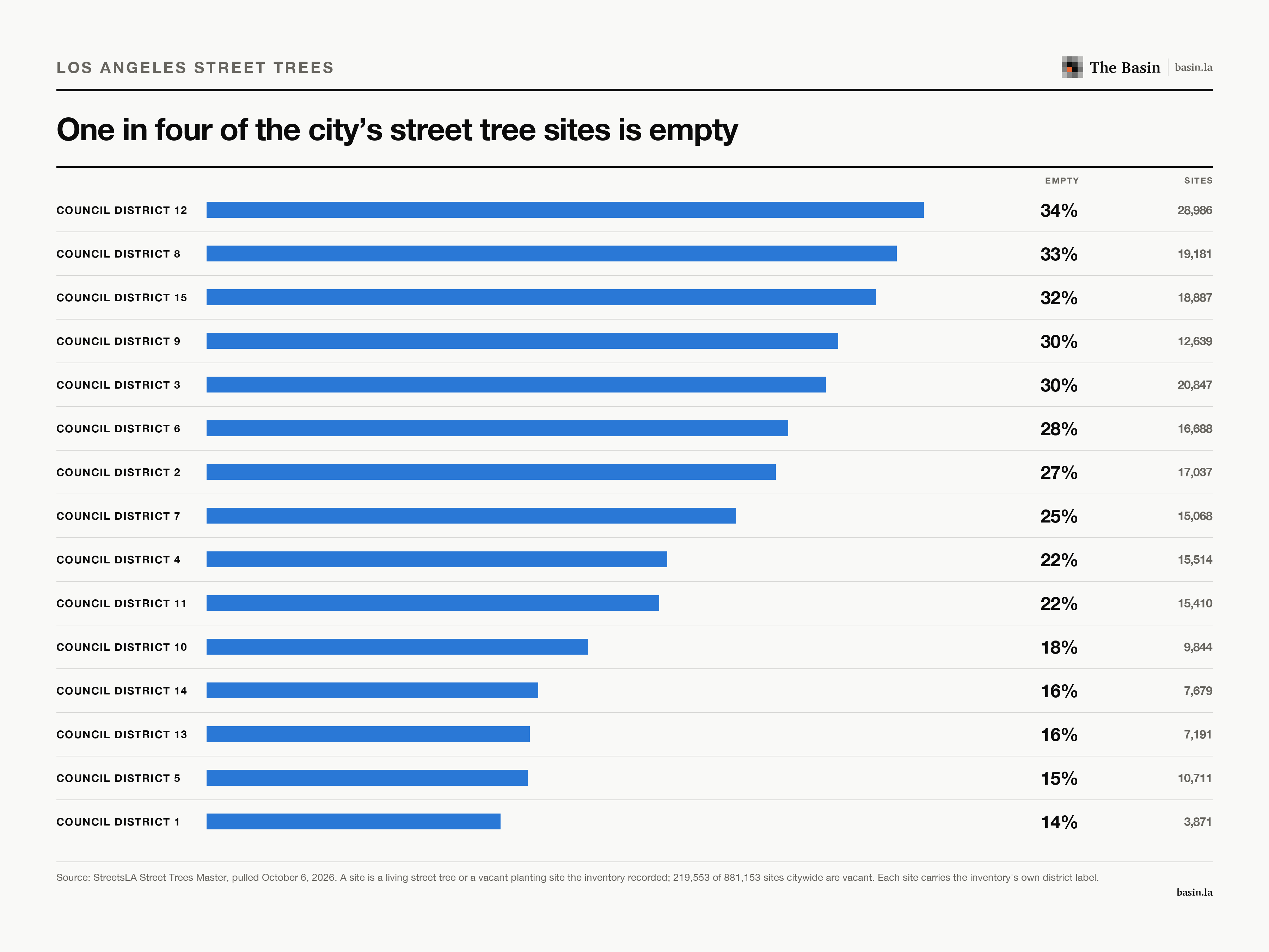
Alongside the 661,600 trees, the arborists recorded 219,553 vacant planting sites, spots in the public right of way that the inventory classes as a place a street tree could stand, with no tree in them. One in four of the sites in the file is empty, 33 empty sites for every 100 trees.
Council District 12, the northwest Valley, has the highest share of empty sites, 34%, with 28,986 of them. Districts 8 and 15, South LA and the Harbor, come next at 33% and 32%, and both rank among the top four districts for palms. Gramercy Park in South LA has more empty sites than trees, 2,119 to 1,894. San Pedro, the neighborhood with the most palms, also has the most empty sites, 7,177.


The Bureau of Street Services plants and trims street trees, and the Controller has audited its trimming twice. A 2019 audit found the bureau trimming street trees on a 14 to 18 year cycle against a recommended five, and a 2023 follow-up found the cycle had slowed to 21 years at more than $400 a tree. The city’s Green New Deal goal, restated in a 2023 council memo, is to raise tree canopy in the areas of greatest need by at least 50% by 2028, and TreePeople has pledged to plant 28,000 trees by 2028 as an Olympic legacy.
Method
The file is the Bureau of Street Services’ Street Trees Master, pulled in full on October 6, 2026. A row counts as a street tree when it carries a species name, palms are the rows whose botanical name is a palm genus, and heights are the arborists’ four bands. Neighborhood figures place each record in the 114 neighborhoods basin.la uses; parks and private property are not in the file.