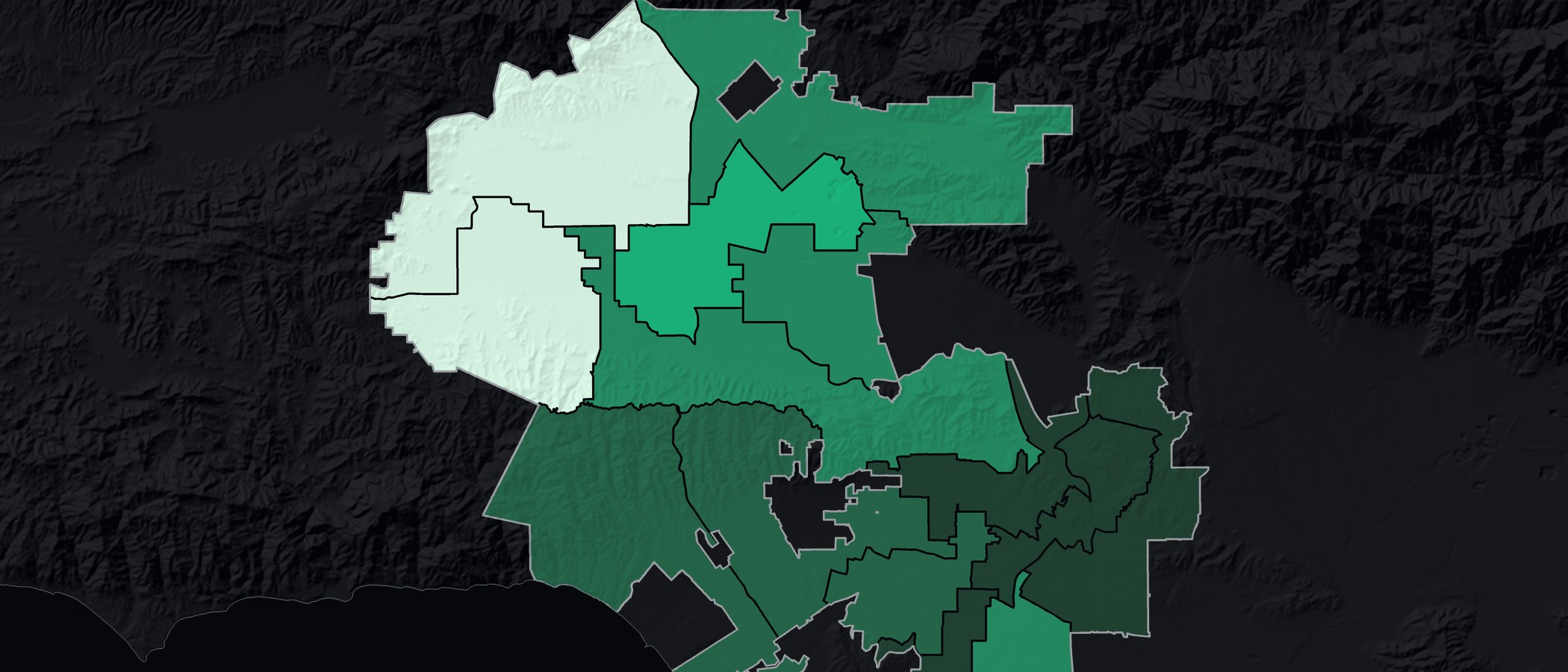
With Election Day on Tuesday, the council districts where Spencer Pratt did best in the June primary have returned the most ballots relative to their June turnout, and the districts where Nithya Raman did best have returned the fewest. Pratt finished third in June with about a quarter of the vote and isn’t on the November ballot, where Raman, a city councilmember, is running against Mayor Karen Bass.
Through Tuesday’s mail and Wednesday’s in-person voting, 263,553 city voters had returned a ballot, according to the county’s ballot files as compiled by the California Republican Party’s data portal. That’s about 30% as many as voted in the June 2 primary. In the two West Valley council districts where Pratt ran best, CD3 and CD12, returns have already reached 34% of the June total, the highest in the city. Pratt finished first in both, with 39.1% of the vote in CD12, which takes in Chatsworth, Porter Ranch and Northridge, and 36.8% in CD3, which runs from Woodland Hills through Tarzana and Reseda.
The three districts where Raman ran best are at the bottom of the list. CD13, which covers Hollywood, East Hollywood and Echo Park and gave her 45.5% in June, has returned 27.2% of its June total. CD1, where she won 39.5%, is at 27.0%, and CD14, which includes downtown, Boyle Heights and Eagle Rock and gave her 37.5%, is at 26.2%, the lowest of all 15 districts. The three cast 18.5% of the city’s ballots in June. They account for 16.4% of the ballots returned so far.


Bass’s strongest districts are also below the city average, though not as far below as Raman’s. Her three best, CD8 and CD9 in South LA and CD10, which runs from Leimert Park to Koreatown, have returned 28.6% of their June total, compared with 30% citywide.
Measuring against June takes each district’s usual turnout out of the comparison. CD9 turned out 22% of its voters in June, and CD11 turned out 53%. Measured against registered voters instead, the order changes: CD4, which Raman represents on the council, leads with 16.2%, and Bass’s CD8 and CD9 are last, as South LA usually is. By that measure, Pratt’s two best districts are still above the city’s 11.9%, at 14.8% and 13.6%, and Raman’s three and Bass’s three are still below it.
Measured against June, the pattern holds across all 15 districts. The larger Pratt’s share of a district’s June vote, the larger the share of its June ballots it tends to have returned now. The larger Raman’s share, the smaller that share tends to be. Bass’s June share has almost no relationship to how much of its June vote a district has returned.
A UC Berkeley Institute of Governmental Studies poll co-sponsored by the Los Angeles Times, taken October 19 to 25, found Bass and Raman tied at 40%, with 19% undecided. The poll’s director, Mark DiCamillo, told the Times the tightening came largely from voters who picked Pratt in the primary. Among those voters, 41% said they now favored Bass and 14% Raman, with 45% undecided, compared with 22% for Bass and 16% for Raman in September. The poll also had Bass ahead in the San Fernando Valley, 44% to 33%. A month earlier, Raman led there 34% to 26%.
Results for groups that small have wider margins of error than the poll as a whole. District returns also don’t show how any individual voted. CD12 gave Bass 31.7% and Raman 19.0% in June, and its returns can’t say who any one ballot is for.
Older voters are returning their ballots faster. Voters 65 and older were sent 23% of the city’s ballots and have cast 47% of those returned so far. Voters 18 to 34 were sent 30% and have cast 12%. About 26% of voters 65 and older have returned their ballots, compared with about 5% of voters 18 to 34. The West Valley’s electorate is also older than the city’s: voters 65 and older were sent 27% of the ballots in CD3 and CD12, compared with 20% in Raman’s three best districts. That accounts for part of the gap.


Raman did best in June where voters were youngest. Among the tenth of June voters who lived in the precincts with the biggest shares of voters under 34, she took 41.4% of the vote, according to the Statewide Database at UC Berkeley’s counts of who voted in each precinct. Among the tenth in the precincts with the biggest shares 64 and older, she took 16.0%. On October 22, Raman’s three best districts had returned 15.8% of their June ballots and Pratt’s two had returned 20.4%. Now the figures are 26.8% and 34.0%. Raman’s districts have gone from 77% of the West Valley’s level to 79%, but the gap in percentage points has widened from 4.6 to 7.2.
Most ballots have not been returned yet. If turnout matches June’s, about 70% are still to come. If the city turns out 45% of registered voters, as it did in November 2022, about 74% are. If turnout grows from June as much as it did in 2022, when the city cast 44% more ballots in the November mayoral runoff than in the June primary, about 79% are.